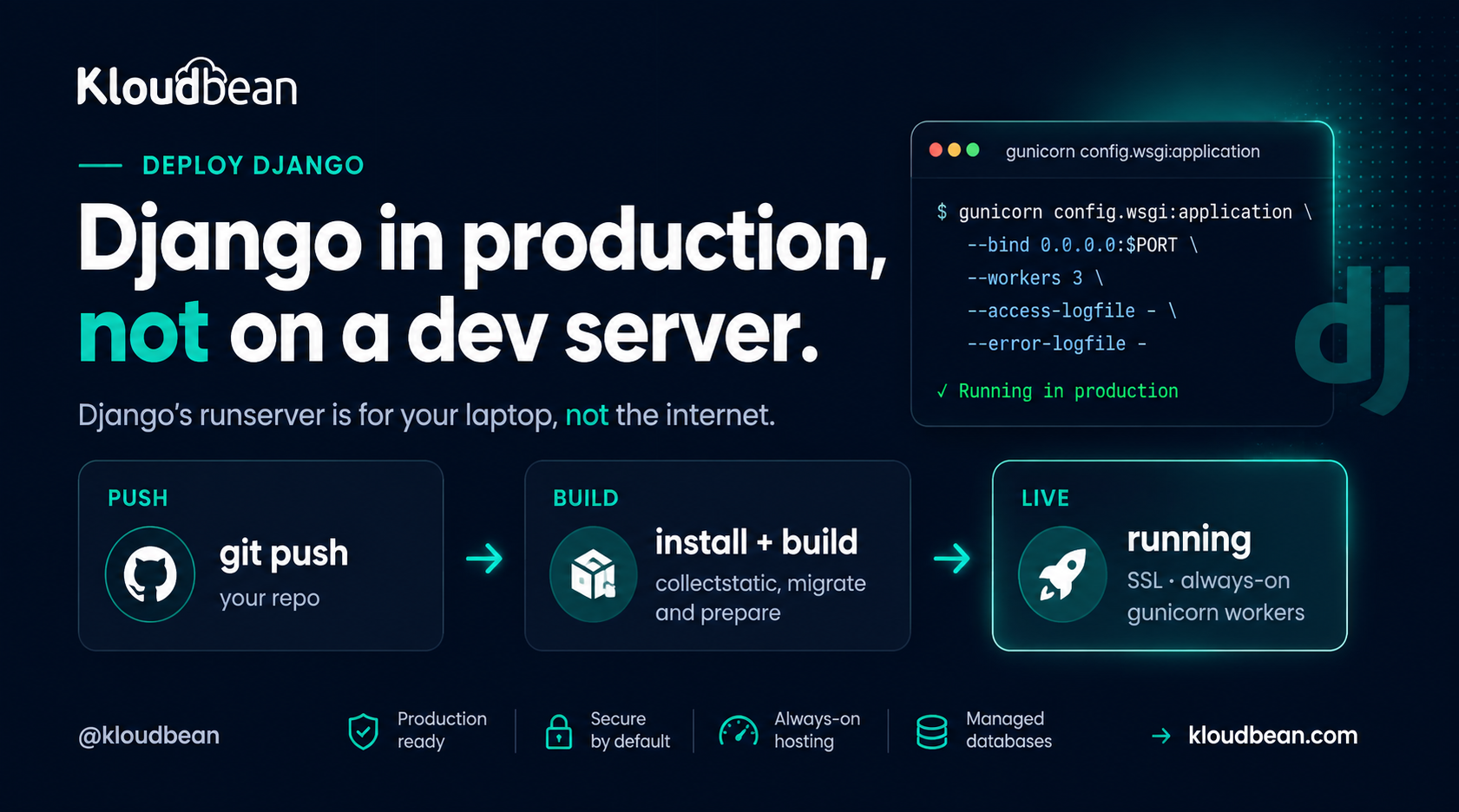
python manage.py runserver is great on your laptop. On the public internet it’s the wrong tool. To deploy a Django app for production you really make two moves: swap that development server for a real one, and flip a handful of settings that are harmless in dev and genuinely dangerous once you’re live.
Most Django tutorials stop at “it runs locally.” This one is the other half. Two checklists, worked top to bottom: the settings that must change, then the deploy steps that put Gunicorn in front of your app. Get both right and your django production server comes up clean the first time, styling and all.
Set DEBUG=False, read SECRET_KEY and the database from the environment, list your domain in ALLOWED_HOSTS. Then deploy: pip install, collectstatic, migrate, and start with gunicorn bound to the assigned port. That’s the whole job. runserver never touches production.
Why runserver stops at your laptop
Django’s own docs are blunt about it: don’t use runserver in production. It’s a development server. It’s single-threaded, it hasn’t been through a security audit, and it isn’t built to hold up under real traffic. That’s not a knock on Django. The dev server exists to give you auto-reload and friendly tracebacks while you build, and it’s excellent at that. It just isn’t a web server.
So a production deploy has a shape. A real web server terminates HTTPS and hands requests to Gunicorn, which runs your Django code across a pool of workers, which talks to a managed database. The diagram below is that path, with the settings that have to change for prod marked on the boxes they affect.
Checklist A: the settings that must change for production
These live in your Django settings and read from environment variables, so one codebase runs safely in both places with different values. Don’t skip any of them.
DEBUG = False. WithDEBUGon, an unhandled error renders a full Django debug page to whoever hit it: your traceback, local variables, parts of settings, installed apps. Off is non-negotiable in production.SECRET_KEYfrom the environment. It signs sessions, password-reset tokens, and more. Read it from an env var, keep it stable, and never commit it.ALLOWED_HOSTS. Set it to your domain(s). Django refuses any request whoseHostheader isn’t on the list, so an empty list means every request 400s.CSRF_TRUSTED_ORIGINS. Add yourhttps://domain so form posts and the admin work correctly behind TLS. Leave it out and every POST comes back as a CSRF token mismatch you can trace to its cause, usually the origin check rather than anything in your forms.- Database from the environment. Point
DATABASESat your managed Postgres via env vars, not the SQLite default. SQLite is lovely in dev and wrong for a real deploy: it lives in a single file on local disk, so it doesn’t survive a rebuild and can’t be shared across workers.
In code that’s a small, boring block near the top of your settings:
# settings.py: production config comes from the environment
import os

DEBUG = os.environ.get("DEBUG", "False") == "True"
SECRET_KEY = os.environ["SECRET_KEY"]          # no default: crash loudly if unset
ALLOWED_HOSTS = os.environ.get("ALLOWED_HOSTS", "").split(",")
CSRF_TRUSTED_ORIGINS = ["https://" + h for h in ALLOWED_HOSTS if h]
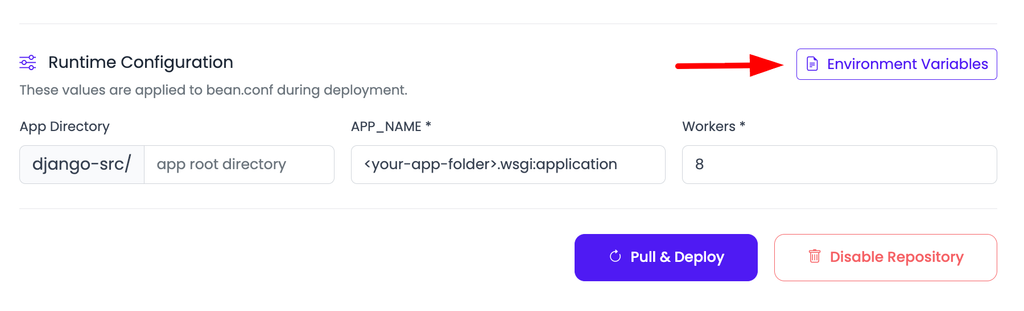
One opinion, stated flatly: DEBUG = True in production isn’t a tidiness problem, it’s a security hole. That pretty yellow error page hands a stranger your stack trace, your settings, and enough of your internals to plan a real attack. Treat a live site running with debug on as an incident, not a to-do. You set these values on the server, never in the repo:
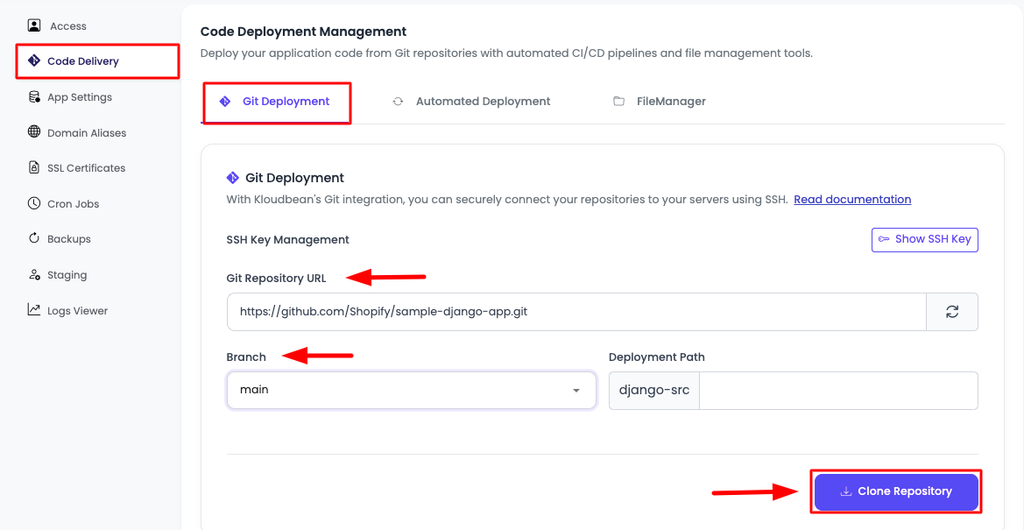
That keeps secrets out of version control and lets you rotate a key without a code change. The reasoning, and the mistakes people make with it, is in environment variables, done right.
Checklist B: deploy your Django app with Install, Build, Start
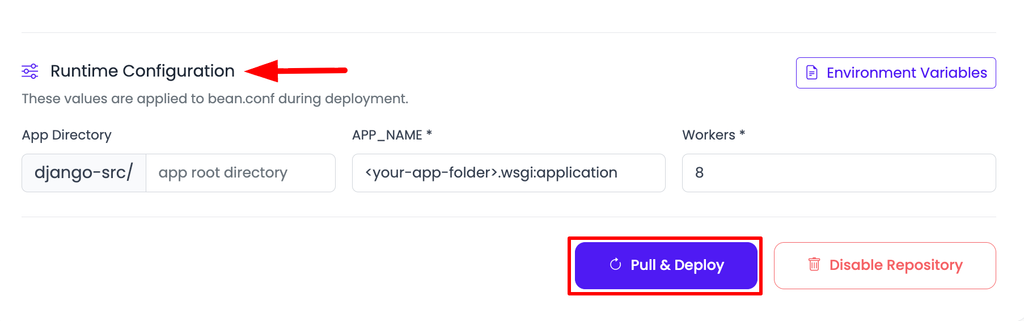
With settings sorted, the deploy is a short sequence. On Kloudbean you connect the repo under Application Administration → Deploy Code → Git Deployment, then fill three fields: Install, Build, and Start.
- Install:
pip install -r requirements.txt. Addgunicornto that file if it isn’t already there. - Build:
python manage.py collectstatic --noinput, thenpython manage.py migrate. Collectstatic gathers every static file into one folder to be served; migrate applies your schema changes so the database matches the code on every deploy. - Start:
gunicorn config.wsgi:application --bind 0.0.0.0:$PORT --workers 3. Swapconfigfor the package that holds yourwsgi.py. The$PORTmatters: bind the port the platform assigns, not a hard-coded one, or the web server in front connects to nothing and you get a 503.
# the three fields, for a project package called "config"
# Install
pip install -r requirements.txt
# Build
python manage.py collectstatic --noinput && python manage.py migrate
# Start
gunicorn config.wsgi:application --bind 0.0.0.0:$PORT --workers 3
Hit Pull & Deploy and the build log streams live while it installs, collects static, migrates, and boots Gunicorn. The whole point of Checklist B is that one swap: Gunicorn, not runserver. Everything else is plumbing.
The collectstatic trap: why your CSS 404s
Here’s the anti-pattern that catches nearly every first Django deploy. The most common question we hear is some version of “the site works but there’s no styling.” Almost every time, collectstatic never ran, so every request for a file under /static/ comes back 404 and the page renders as naked HTML. The app is fine. The static files just aren’t where the server looks for them.
The fix is two parts. Run collectstatic in your Build step (above), and give Django something to actually serve those files with. The simplest option by a mile is WhiteNoise: pip install whitenoise, add its middleware, and your app serves its own static files with proper caching and no separate config. For a single app, that’s the least-effort win.
Static vs media: two different problems
Django splits files into two buckets, and they’re handled differently. Mixing them up is the second-most-common deploy mistake.
- Static files ship with your app (CSS, JS, the admin’s assets). They’re known at build time, gathered by
collectstatic, and served by WhiteNoise or the web server. They never change at runtime. - Media files are user uploads, created while the app runs. On a single server the local media directory works. The moment you run more than one server, or you want uploads to survive a rebuild, point Django’s storage at S3-compatible object storage. Uploads then live independently of the app box, which is where they should be for anything real.
How many Gunicorn workers?
Gunicorn runs your app in a pool of worker processes, and the default of one leaves performance on the floor. A well-worn starting point is (2 × CPU cores) + 1, so a 2-core server runs about 5 workers. That handles concurrent requests comfortably without swamping the box. Don’t crank it to 50. Each worker is a separate process holding its own memory, and too many will exhaust a small server and make everything slower, not faster. Start with the formula, watch memory, adjust. If your app spends most of its time waiting on the network, gevent or async workers can help, but plain sync workers are the right default for most Django apps.
Migrations, the database, and HTTPS
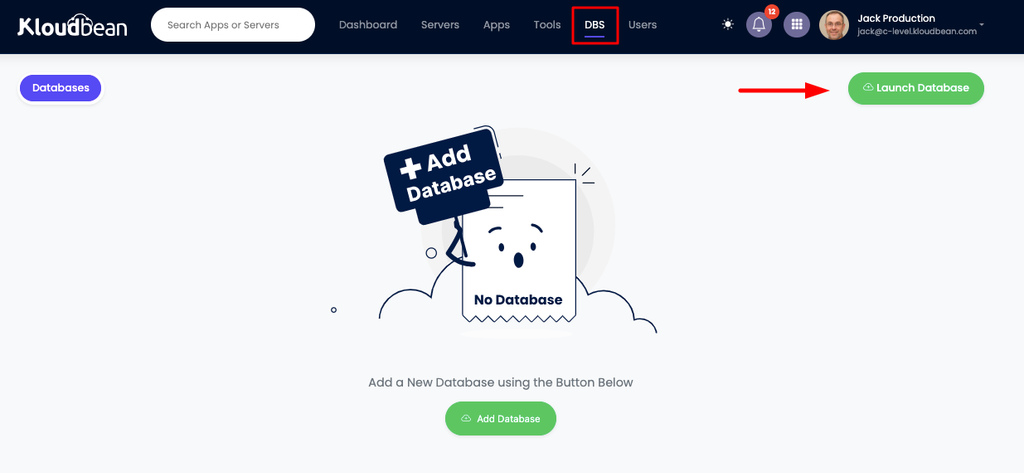
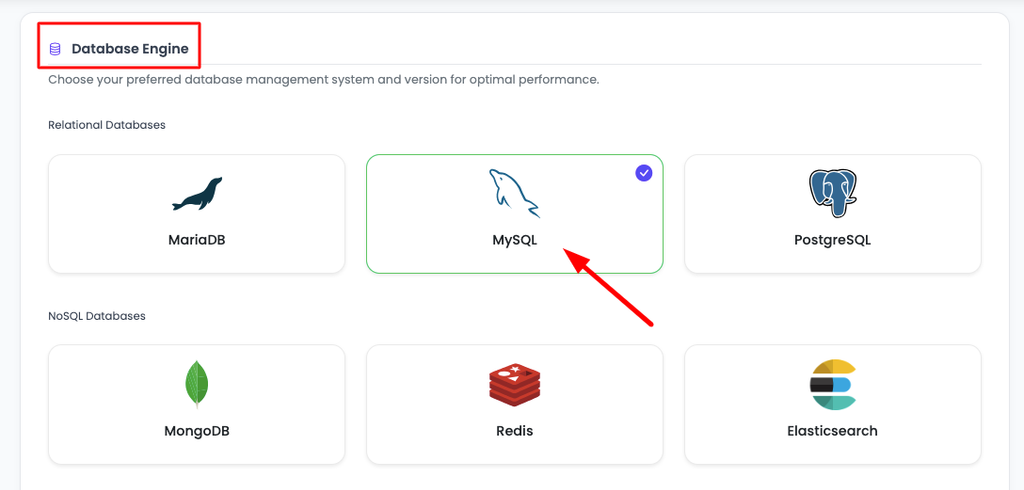
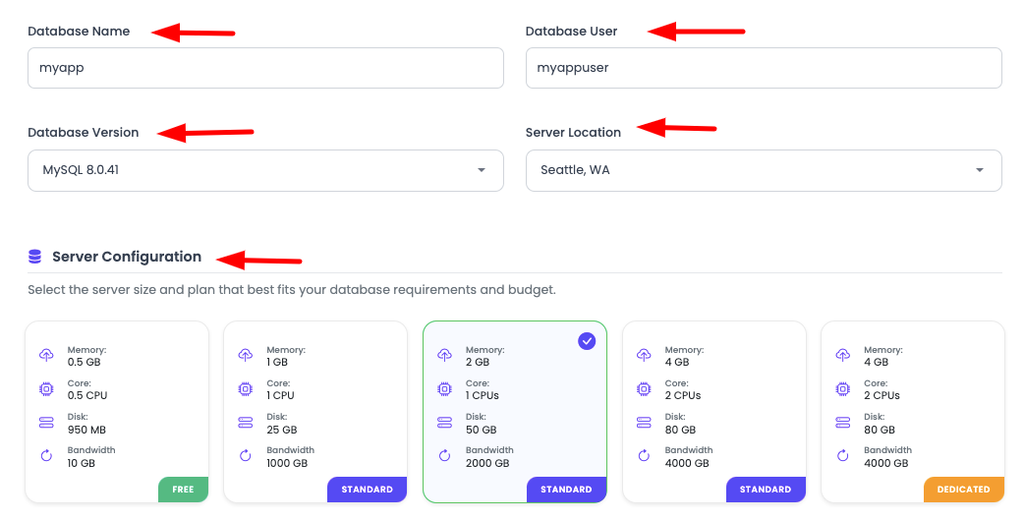
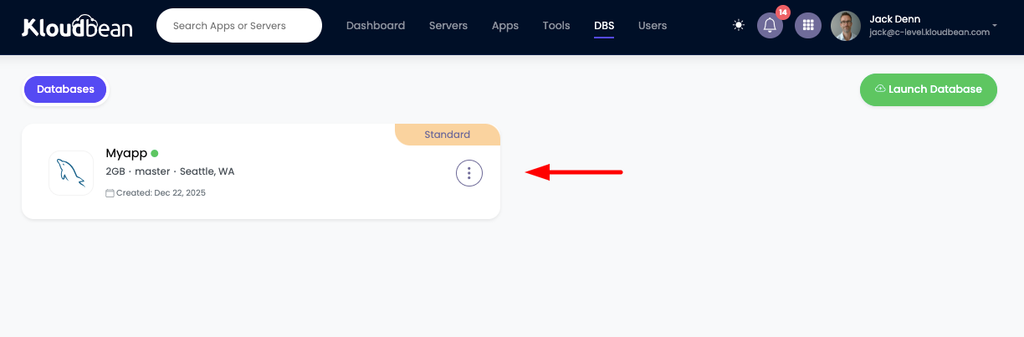
Run migrate on every deploy (it’s in your Build step) so the schema never drifts behind the code. Skip it after a model change and the first request that touches the new column throws. For the database itself, launch a managed Postgres from DBS → Launch Database and reach it over the local network on the same box. It’s backed up, and your app finds it through the DATABASES env var from Checklist A.
Then point your domain at the server and install a free Let’s Encrypt certificate. Django’s CSRF and secure-cookie behaviour expects HTTPS, so this isn’t optional dressing. Turn on automated deployment and every push re-runs collectstatic and migrate and restarts Gunicorn. Your update loop becomes one step: push, and production catches up. More on the shared-box setup in host your app, API, and database on one server, and on managed Postgres specifically in managed PostgreSQL hosting.
When it breaks: the three first-deploy errors
Django’s opening-night failures are predictable, and each maps straight back to a checklist item:
- DisallowedHost, a 400 on every page. Your domain isn’t in
ALLOWED_HOSTS. Add it, redeploy. - A 500 with no detail. That’s
DEBUG = Falsedoing its job, which is correct. The real cause is usually a missingSECRET_KEYor wrong database credentials. Read the log; the traceback names it. - Loads but unstyled. The collectstatic trap. Static files aren’t served: either the build step didn’t run
collectstatic, or WhiteNoise isn’t wired up.
The traceback is in the dashboard, not somewhere you need SSH to reach. Open Application Administration → Logs Viewer, where the logs are split into tabs: App Errors for the app’s error log (that’s your Django traceback, and the first place to look if you get a 503, because a 503 means the app isn’t running at all), App Info for its informational output, and Web Requests Logs for the web server’s access log. There’s a search box, which matters with Django because a traceback buried under a few thousand request lines is a pain to find by eye. Build failures are separate: that output streams live and is kept in Build and Deployment History, so a collectstatic or migrate error is visible there. The same two files sit on disk at /home/admin/hosted-sites/<app_system_user>/app-logs/ (app.error.log and app.info.log) if you prefer a terminal or the File Manager. Read one of them before you start changing code on a hunch. The full walkthrough is in fixing a 503 after deploying your app.
If you use Celery
Plenty of Django apps push slow work (emails, image processing, report generation) onto Celery. If yours does, remember Celery is its own process, separate from Gunicorn. A Celery worker runs the queued tasks and Celery beat runs the scheduled ones. Run both as persistent processes alongside the web app, pointed at a broker like managed Redis. No worker running means tasks queue up and never execute, which is a genuinely confusing bug the first time it bites. Not using Celery? Skip this entirely.
What you own, what Kloudbean runs
Django is a Python app, and Python on Linux is exactly what a managed server runs, so nothing here is a workaround. Kloudbean keeps the box healthy: the Python runtime, the web server in front of Gunicorn, SSL, firewall, and server-level backups, on whichever of its seven clouds you pick. You own the Django project: its settings, its migrations, its static and media strategy, any Celery processes. It’s a Linux server running standard Python, so you can move hosts whenever you like. Building in other frameworks too? The async sibling is deploy a FastAPI app, and the minimal one is deploy a Flask app.

Your Django app deserves a real production home.
Move beyond runserver. Deploy Django on an
always-on production server with managed infrastructure,
automatic backups, SSL and Git-based deployments — all
from one dashboard.
FAQ
Can I run Django with manage.py runserver in production?
No. It’s a development server and Django explicitly warns against it. In production you run Gunicorn (or another WSGI server) with the managed web server in front. Use runserver only on your machine.
What settings must change before going live?
DEBUG = False, a SECRET_KEY read from the environment, ALLOWED_HOSTS set to your domain, CSRF_TRUSTED_ORIGINS with your HTTPS domain, and a real database (Postgres) via env vars. Those five matter most.
Is DEBUG = True really a security risk in production?
Yes. With debug on, any unhandled error shows a detailed page containing your traceback, parts of your settings, and local variables. That hands an attacker a map of your app. Keep it off in production, always.
Why is my Django site missing its CSS after deploy?
Static files aren’t being served. Run collectstatic in your build step, then serve the files with WhiteNoise or the web server. Broken styling after deploy almost always traces back to skipped or unserved static files.
Where should user uploads (media) go?
On a single server, the local media directory works. If you scale to multiple servers or want uploads to survive a rebuild, point Django’s storage at S3-compatible object storage, which Django supports cleanly.
Do I need to run migrations on every deploy?
Yes. Run python manage.py migrate as part of each deploy so the schema stays in step with your code. Skip it after a model change and the app errors the moment it touches the missing column or table.
Do I use Gunicorn or Uvicorn for Django?
Gunicorn. Django is a WSGI app, and Gunicorn is the standard WSGI server for it. You only reach for an ASGI server like Uvicorn or Daphne if you’re using Django’s async views, channels, or websockets.
Do I need Docker to deploy a Django app?
No. A single Django app is a process behind Gunicorn, and a managed server runs it directly. Docker and Kubernetes solve orchestration problems that show up with many services at scale. For shipping one app, you can skip them.
Kloudbean · Django in production, not on a dev server.