The MySQL vs PostgreSQL argument has been running since before some of the people arguing were born. It gets loud. It rarely gets useful. So here’s a calmer take from the side of someone who has run both in production and cleaned up after both: yes, the choice is real, and no, you won’t sink your project by picking the “wrong” one.
What you want isn’t a scoreboard. You want a rule you can apply in five minutes and defend in code review. So this guide gives you the rule first, then the engineering reasons behind it.
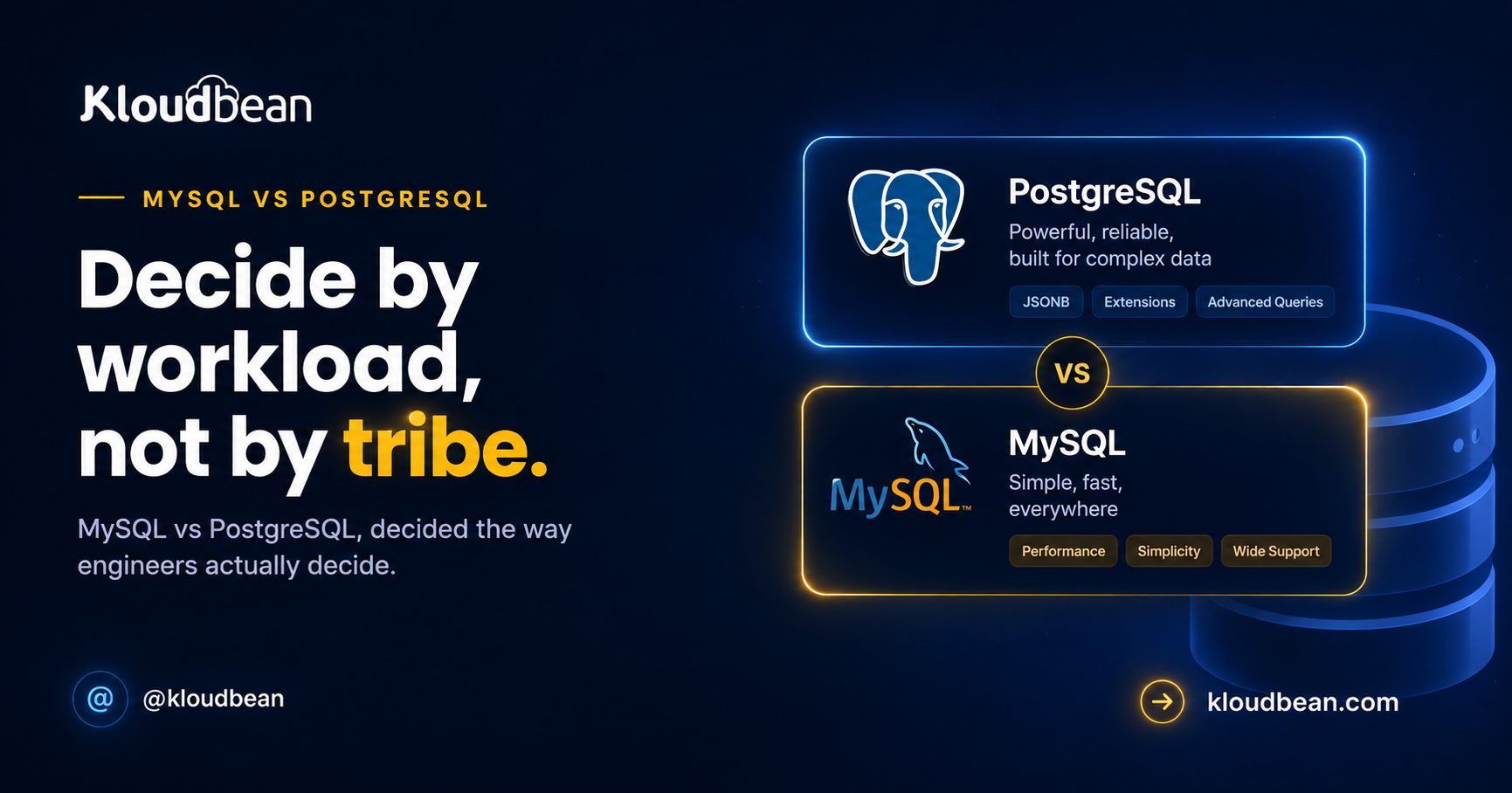
Reach for PostgreSQL when data integrity, complex queries, or rich types (JSONB, arrays, PostGIS, pgvector) matter, and as a sensible default for a new app. Reach for MySQL (or MariaDB) for straightforward read-heavy web apps, the WordPress and LAMP world, and maximum familiarity. If your team is already fluent in one, that’s usually the right one. Both are excellent, so decide on fit, not folklore.
How I’d actually choose
If you handed me a blank repo and no other context, I’d start on PostgreSQL. It’s the stricter, more capable engine, and it’s what most modern frameworks and ORMs assume now. That’s a default, not a dogma. The moment real context shows up, the context wins.
Building on WordPress, WooCommerce, or a classic PHP stack? Use MySQL or MariaDB. You’d be fighting the entire ecosystem to do otherwise, and you’d lose. Got a team that ships MySQL in their sleep and a deadline next week? Use MySQL. A database your team knows cold beats a “better” one they’ll be Googling at midnight. Familiarity is a real feature, and it doesn’t show up on any comparison chart.
The honest bit most articles skip: for a typical CRUD web app with a few thousand users, you could flip a coin and be fine. The differences below decide the edges. Knowing the edges is how you choose on purpose instead of by vibe.
MySQL vs PostgreSQL: the differences that actually decide it
Most of the two databases overlap. They both do tables, transactions, indexes, joins, ACID, and replication, and both have for years. The parts that differ are narrow but they’re exactly the parts that flip a real decision. Here they are, in the order they tend to matter.
Data types and JSON
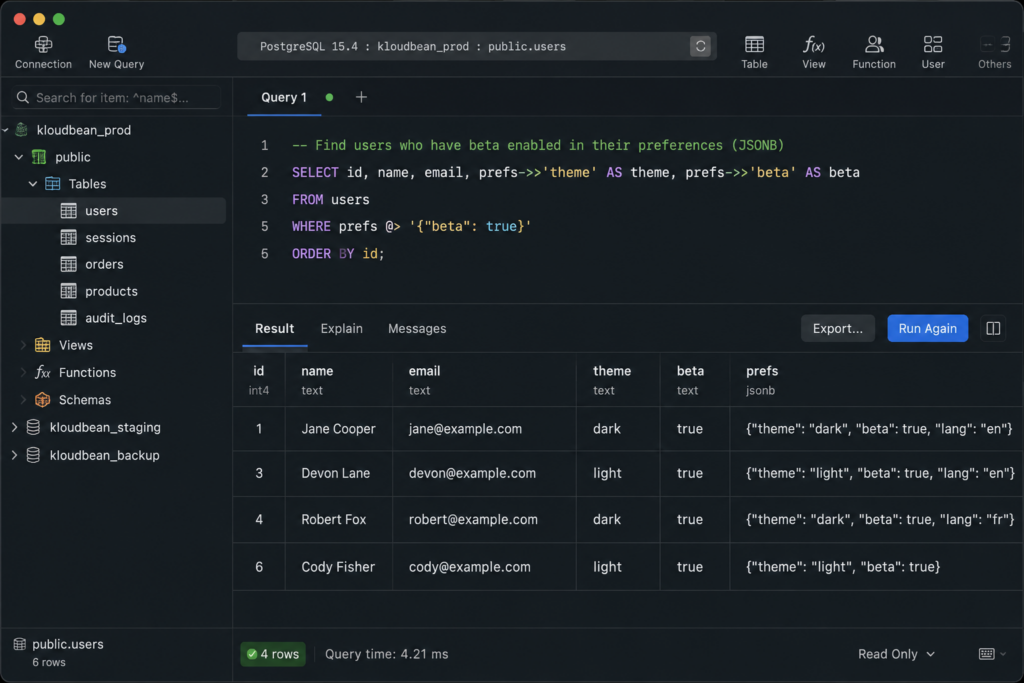
This is the biggest practical gap. PostgreSQL treats your data model as a first-class thing. It has native arrays, real boolean and UUID types, ranges, custom composite types, enums, and its JSONB support is genuinely excellent. JSONB is binary, indexable JSON, so you can store a semi-structured blob and still query and index inside it fast.
-- PostgreSQL: index JSON and query inside it
CREATE INDEX idx_prefs ON users USING GIN (prefs);
SELECT id FROM users WHERE prefs @> '{"beta": true}';
MySQL has a JSON type too, and it’s fine for storing and pulling back documents. It’s just less of a Swiss Army knife. If your app leans on flexible, document-shaped data, Postgres gives you room MySQL doesn’t hand over as easily. Many teams pick Postgres for this reason alone.
Strictness and the SQL standard
Postgres is strict by default and closely tracks the SQL standard. Feed it a value that doesn’t fit the column and it refuses, loudly, at write time. That sounds annoying until the day it saves you from silently corrupting a month of data. MySQL has historically been more forgiving, and older setups would quietly truncate or coerce bad input. Modern MySQL fixed the worst of this, but you sometimes still confirm the mode is right:
-- MySQL: reject bad data instead of silently coercing it
SET GLOBAL sql_mode = 'STRICT_ALL_TABLES';
If your data has to be trustworthy (money, inventory, anything regulated), Postgres’s default posture is the safer starting point. You have to opt out of strictness rather than remember to opt in.
Complex queries, concurrency, and MVCC
Both engines use MVCC (multi-version concurrency control), so readers don’t block writers and vice versa. That myth about one of them locking up under load is old news. Where they still diverge is the hard stuff. Postgres has a more sophisticated query planner and a deeper toolbox for gnarly analytical work: window functions, common table expressions, full outer joins, materialized views, and a planner that tends to make smarter choices on multi-join, multi-condition queries. MySQL closed much of this gap and handles complex queries perfectly well for most apps. But if reporting, analytics, or intricate joins are core to what you’re building, Postgres is the more comfortable home.
| Capability | MySQL / MariaDB | PostgreSQL |
|---|---|---|
| JSON / rich types | Good (JSON type) | Excellent (JSONB, arrays, custom types) |
| Strict by default | Configurable (sql_mode) | Yes, standard-tracking |
| Complex queries / analytics | Good | Very strong (planner, CTEs, windows) |
| Extensions | Limited | Rich (PostGIS, pgvector, and more) |
| Replication | Mature, simple, battle-tested | Streaming + logical, very capable |
| Ecosystem / ubiquity | Enormous (WordPress, LAMP, shared hosting) | Large and growing fast |
| Reputation | Fast, simple, everywhere | Powerful, precise, extensible |
| Learning curve | Gentle | Slightly steeper |
Extensions, the Postgres superpower
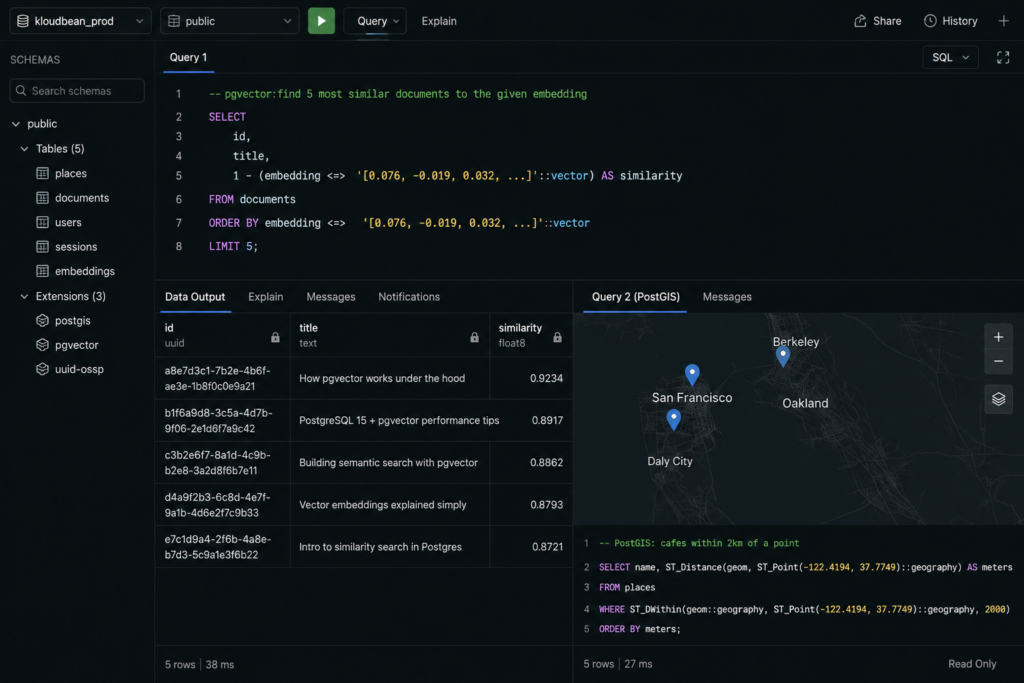
This one has no real MySQL equivalent, and it’s why so many teams quietly standardize on Postgres. Extensions bolt whole new capabilities onto the database without leaving it. PostGIS turns Postgres into a serious geospatial engine. pgvector turns it into a store for the embeddings behind AI search, so a lot of RAG and semantic-search stacks just use Postgres and skip a separate vector database. If there’s any chance your product grows in those directions, that optionality is worth a lot.
Replication and the pull of the MySQL ecosystem
MySQL earns its enormous install base here, and it’s not nostalgia. Its replication is mature and well-understood, and decades of tooling, tutorials, and hire-able expertise have grown around it. It’s the database of WordPress, a huge slice of the web, and the default on most shared hosting. If you live in PHP, or you want the widest pool of people who can operate your database at 2am, MySQL or MariaDB is the frictionless path. Postgres has excellent replication too, both streaming and logical. But the gravity of the MySQL ecosystem is a real reason to choose it, especially for content sites and standard web apps. It’s also why people go looking for a PlanetScale alternative that is just plain managed MySQL: they want the ordinary engine and a normal connection string, not a platform-specific workflow wrapped around it.
Where people pick wrong
A few patterns come up again and again, and they’re all avoidable.
- Picking Postgres for a WordPress site. WordPress is built on MySQL. Choosing Postgres here means fighting plugins, hosts, and every tutorial you’ll ever read. Don’t. Use MySQL or MariaDB and move on.
- Picking MySQL, then needing what Postgres has. The team ships on MySQL because a tutorial did, then six months later they want PostGIS or pgvector and end up bolting on a second database. If you can see that future, start on Postgres.
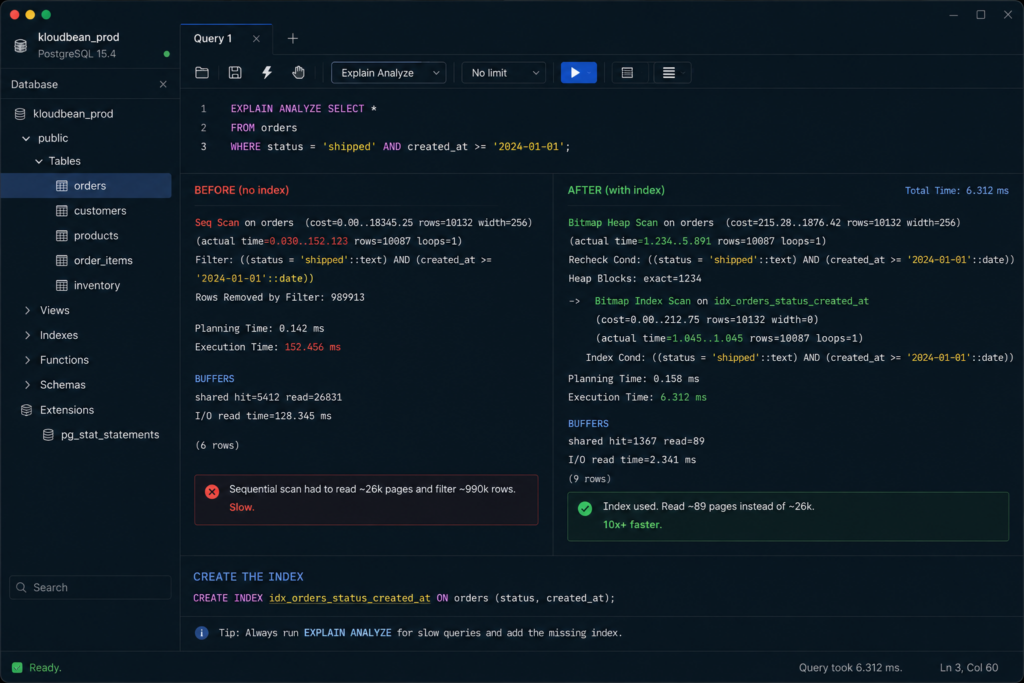
- Choosing on a benchmark you found online. Someone else’s numbers, on someone else’s hardware, running someone else’s query, tell you almost nothing about your app. If performance actually matters, run
EXPLAINon your own slow query and add the missing index. That’s where the real wins are.
And while we’re clearing the air, retire two ancient beliefs. “Postgres is slow” is decades out of date; on complex queries it’s often the faster one now. “MySQL can’t handle serious work” is equally false; it runs some of the largest sites on earth. Both grew up and borrowed each other’s best ideas. Choose on fit, not on stale trash talk.
What about MariaDB?
Fair question, it comes up constantly. MariaDB is a community fork of MySQL from MySQL’s original author, designed as a near drop-in replacement: same SQL, same clients, largely the same behavior. For choosing an engine, treat “MySQL or MariaDB” as one camp. If MySQL fits, MariaDB fits, and plenty of hosts and WordPress installs run one or the other without anyone noticing. The decision that actually matters is that camp versus PostgreSQL.
The verdict, stated plainly
No hedging. Here’s the call.
- PostgreSQL for a new app with no strong constraint, for rich or semi-structured data, for strict integrity, for analytics, and for anything AI-adjacent. It’s the better default and the one with more headroom.
- MySQL / MariaDB for WordPress and the PHP world, for simple read-heavy web apps, and when you want the biggest, most familiar ecosystem behind you.
- Whatever your team already knows when neither case is strong. Shipping beats theory.
Both are mature, actively developed, free, and open source, and both will outrun what most projects ask of them. This is a fit decision, not a bet you can lose.
You don’t have to marry one
Here’s the part that takes the pressure off. On Kloudbean, MySQL and PostgreSQL are both one-click managed engines, next to MariaDB, Redis, Elasticsearch, and MongoDB. You launch the one you chose, get a connection string, point your app at it, and it’s backed up from minute one and locked to your app server’s IP so only it can connect.
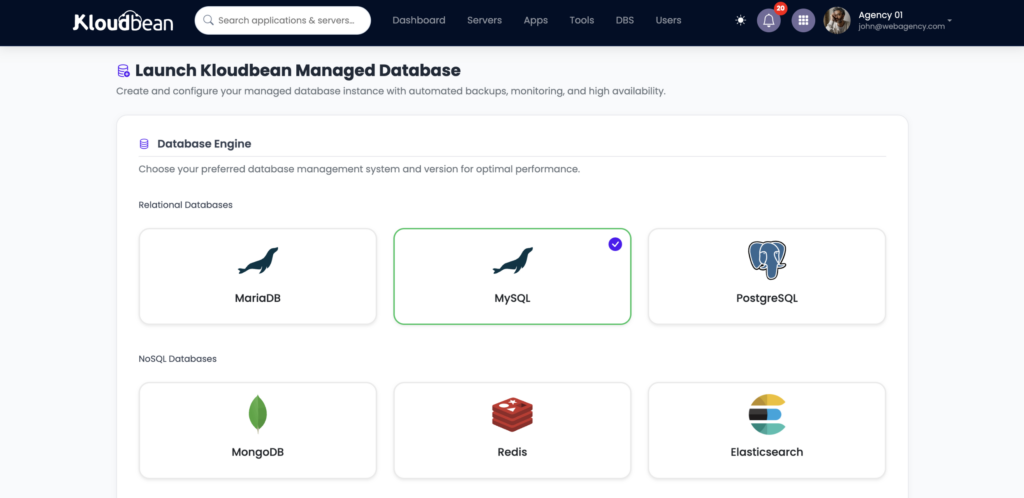
Because it’s a click, you can pick per project, or run both: Postgres for the app that needs JSONB, MySQL for the WordPress site beside it. Your app reads its connection from an environment variable, so pointing it at an engine is config, not code.
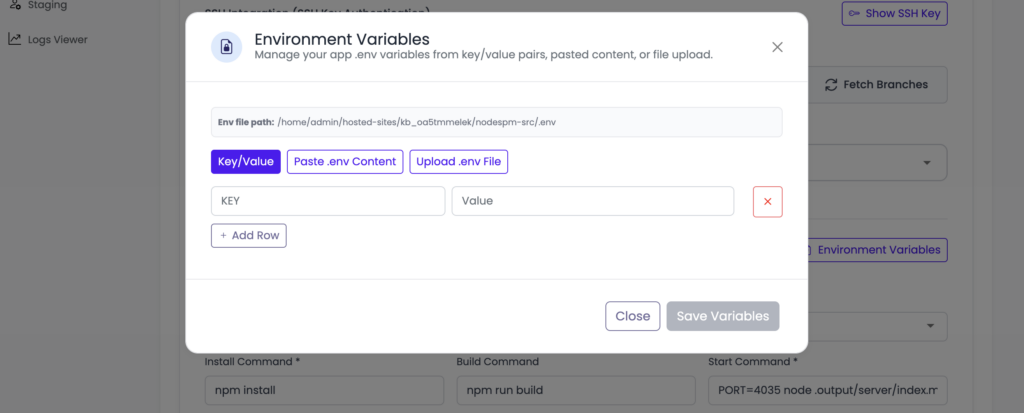
# Same app, whichever engine you picked
DATABASE_URL=postgresql://appuser:[email protected]:5432/ap¸pdb
DATABASE_URL=mysql://appuser:[email protected]:3306/appdb
Managed here means the platform runs and patches the engine, locks it down so only your whitelisted app server can reach it, and backs it up, while your schema and data stay yours and exportable anytime. Both engines run on Linux, where nearly every web app lives. For the deeper how-to, see adding a managed database to your app, or the guides for managed MySQL hosting and managed PostgreSQL hosting. Rather run it yourself? Managed vs self-managed weighs that honestly. When reads pile up, read replicas are the usual next step for either engine, and a managed Redis cache takes pressure off both.
Pick the engine that fits, run it managed, get back to building.
MySQL and PostgreSQL, launched in a click, backed up automatically, and locked to your app server’s IP, with your data yours to export whenever you like.
One-click MySQL or PostgreSQL · Automatic backups · Free migration help · Free trial · Start at kloudbean.com · See pricing.
FAQ
Is PostgreSQL better than MySQL?
Neither is universally better. Postgres is the more capable and stricter engine, so it wins for rich types, complex queries, and data integrity. MySQL is fast, simple, and everywhere, so it wins for standard web apps and the WordPress world. Pick on your project’s needs and your team’s familiarity, not on a ranking.
Which is faster, MySQL or PostgreSQL?
It depends on the workload, and the old “MySQL is fast, Postgres is slow” line is out of date. MySQL can edge ahead on simple read-heavy queries, while Postgres often wins on complex, multi-join, analytical work. For most apps the bottleneck is a missing index, not the engine. Run EXPLAIN on your own slow query before blaming either one.
Which should I choose for a new project?
With no strong constraint, start on PostgreSQL. It’s the stricter, more feature-rich engine and it’s what most modern frameworks assume, so you get room to grow into JSON, analytics, or AI features. Switch that default only if your ecosystem or team points the other way.
Is MySQL or PostgreSQL better for WordPress?
MySQL, or its drop-in cousin MariaDB. WordPress is built on MySQL, and its plugins, hosts, and tutorials all assume it. Postgres is great generally, but for WordPress specifically you’d be swimming upstream for no benefit.
When is PostgreSQL the clear winner?
When you need advanced SQL and analytics, rich JSONB handling, strict integrity, or extensions. PostGIS makes it a first-class geospatial database, and pgvector makes it a store for AI embeddings, which is why many similarity-search stacks just use Postgres.
What is MariaDB, and how is it different from MySQL?
MariaDB is a community fork of MySQL by its original author, built as a near drop-in replacement with the same SQL and clients. For choosing an engine, treat MySQL and MariaDB as one camp. The differences rarely change a project-level decision.
Which is better for Django, Rails, or Node?
All three run happily on either engine through their usual database drivers and ORMs, so this isn’t the deciding factor. That said, Django and Rails communities lean Postgres, and it’s a common default in the Node and Prisma world too. If you have no other reason to choose, following your framework’s grain is a fine tiebreaker.
Can I switch databases later?
You can, but it’s real work: SQL concepts transfer, yet syntax, types, and data migration take effort, so choose thoughtfully up front. The good news is that for most apps either engine serves well, so you rarely need to switch. Running whichever you pick as a managed service keeps operations simple either way.
Can I run both MySQL and PostgreSQL?
Yes, and it’s common. Different projects have different needs, so you might run Postgres for an app that leans on JSONB and MySQL for a WordPress site beside it. On a platform where each is a one-click managed engine, running both is just two launches and two connection strings.
Kloudbean · Decide by workload, not by tribe.