You close a deal with a Saudi bank or a government supplier, and the security review comes back with one line: where is our data stored? That question is what data residency in Saudi Arabia comes down to. Not the cloud brand. Not the vCPU count. The country your bytes physically sit in. This is a guide to keeping data in Saudi Arabia for real: how in-Kingdom residency works, the spots where your data quietly slips out of the country (a backup, a CDN edge, a third-party API), and how to verify it so you can answer that email without guessing.
Most teams treat this as a lawyer problem. It’s mostly an engineering one, decided the moment you pick a region, then re-checked whenever something new starts holding a copy. Get it right at launch and the security review is a shrug. Get it wrong and you’re migrating a live database while a procurement clock runs down.
Launch on an in-Kingdom region and keep every copy there. On Kloudbean that region is Google Cloud’s Dammam (me-central2), physically inside Saudi Arabia: pin the server to it, launch the managed database in the same region, and make sure backups write in-region. Then verify the parts that move quietly, your CDN cache, logs, and any third-party service you send data to. Residency is set at launch and checked on a schedule, never assumed.
Data residency vs data sovereignty in Saudi Arabia
Data residency is where your data physically lives: the country and data center that hold the actual bytes. Data sovereignty is the consequence of that location: whichever country holds the data, its laws reach it. The two travel together. Store data inside Saudi Arabia and you’ve placed it under Saudi law, including the Personal Data Protection Law (PDPL). Store it in Frankfurt and you’ve handed it to EU rules instead.
So data sovereignty in Saudi Arabia isn’t a separate switch. It comes bundled with the location: put the bytes in the Dammam region and Saudi jurisdiction applies. That’s what people miss when they shop on price alone. Choosing a region is choosing a legal regime, not just a latency number. New to the concept? The plain-English version is in data residency explained; this page is the Saudi-specific take.
One more line worth keeping straight. Residency is about location. PDPL data residency expectations go further, covering what you may do with personal data on people in the Kingdom and when it may cross a border. Keeping data in-Kingdom answers the location question, not the rest of PDPL.
Why data residency in Saudi Arabia matters
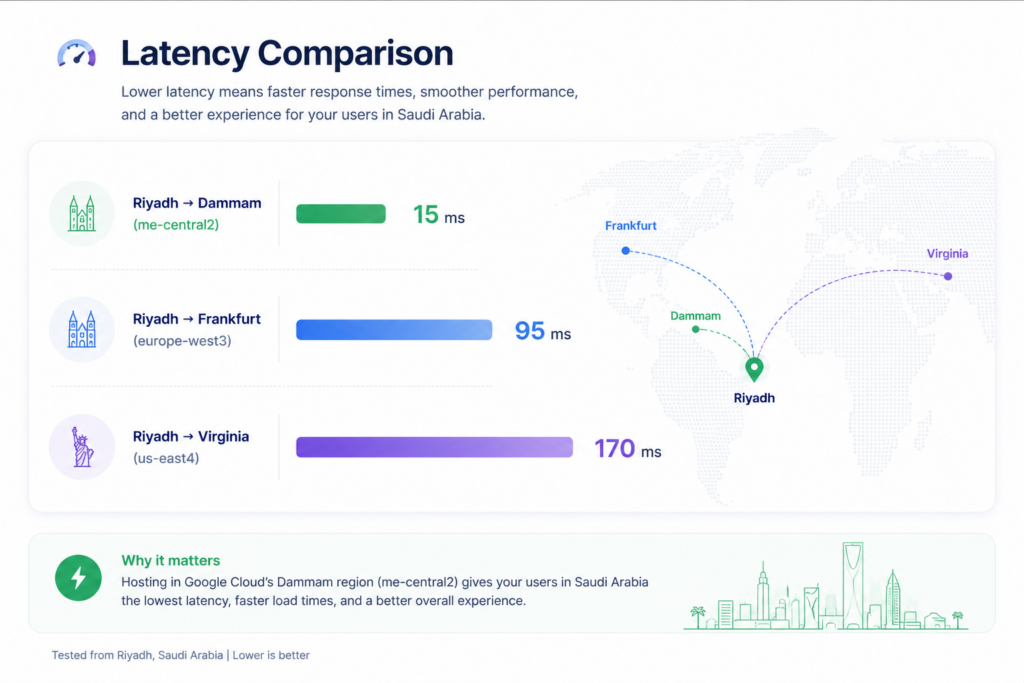
Three things push Saudi-facing teams toward in-Kingdom data, and none is really about speed. Latency is real too, and the cloud hosting in Saudi Arabia pillar covers it. Here the drivers are legal and commercial.
PDPL and SDAIA. Saudi Arabia has a genuine data-protection law, the PDPL, overseen by SDAIA (the Saudi Data and AI Authority). It governs how personal data on people in the Kingdom is collected, processed, and moved abroad. For plenty of workloads, especially government-adjacent, financial, and health data, keeping that data in-Kingdom is expected or effectively required. Residency doesn’t make you compliant by itself, but it removes the hardest part to retrofit later: location.
Procurement asks first. “Where is my data stored?” is often the opening question in a Saudi tender, not the closing one. A clean answer (your data sits in the Dammam region, inside Saudi Arabia) keeps the deal moving; “Europe, but it’s very secure” tends to stall it. Vision 2030 and the Kingdom’s cloud-first direction have only sharpened that expectation.
Trust, plainly. Local customers increasingly want to know their data doesn’t leave the country. Being able to say it does not, and point at where it lives, is a selling point. In-Kingdom data is now part of how Saudi buyers judge whether you take them seriously.
Here’s the goal in one picture: every copy of your data inside one Saudi boundary, and the one copy that tries to escape, usually a backup or a cache, stopped at the border.
More than websites: complete application infrastructure
Keeping data inside Saudi Arabia isn’t just about where a website lives. Modern applications usually consist of several moving pieces: an application server, one or more databases, uploaded files, background workers, APIs, scheduled jobs, caching, and sometimes automation platforms. Looking only at the web server tells only half the story.
That’s why every component deserves the same residency decision. Whether you’re deploying WordPress, WooCommerce, Laravel, Django, Node.js, FastAPI, PHP, Docker containers, Java applications, or self-hosted tools like n8n, the principle stays the same. The application, its database, uploaded files, backups, and supporting services should all be launched into the same in-Kingdom region so every copy stays where you expect it.
How to guarantee your data stays inside Saudi Arabia
Guaranteeing residency is less about one big setting and more about making every copy land in the same place. Four things carry the weight; get all four into the Dammam region and your data provably stays in the Kingdom.
1. Pin the server to the in-Kingdom region
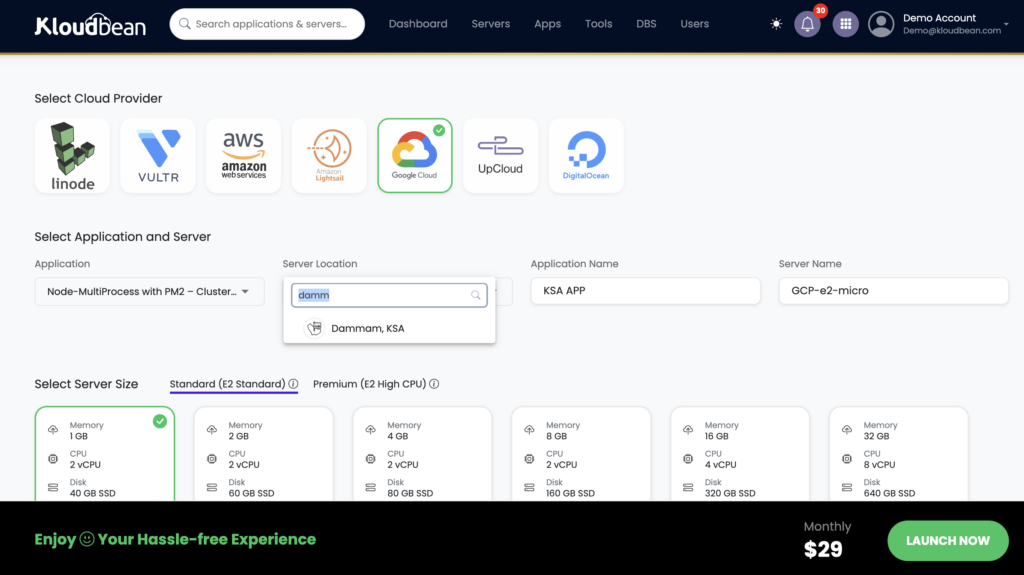
This is the decision that anchors everything else. When you add a server you choose the cloud and the region. Among Kloudbean’s seven clouds (AWS, AWS Lightsail, Google Cloud, Linode, Vultr, DigitalOcean, and UpCloud), the in-Kingdom option is Google Cloud’s Dammam region, me-central2, physically inside Saudi Arabia. Other providers run Saudi regions too, but that GCP region is the in-Kingdom choice in Kloudbean’s lineup. Pick it and your server lives in the Kingdom; pick a vague “Middle East” label and you might land in Bahrain, the UAE, or Europe instead. Confirm the exact region, not the marketing word.
2. Keep the database in the same region
Your database is where the personal data actually lives, so it matters most. Launch the managed engine (PostgreSQL, MySQL, MariaDB, Redis, and more) into the same Dammam region, on a private network (VPC) rather than the open internet. A common mistake we see is moving the app in-Kingdom while the database quietly stays in a default US or EU region, so the sensitive data never actually came home. Same region for both, every time. The full app-and-database wiring is in how to add a managed database to your app. The only Saudi-specific step is pinning the region to Dammam first.
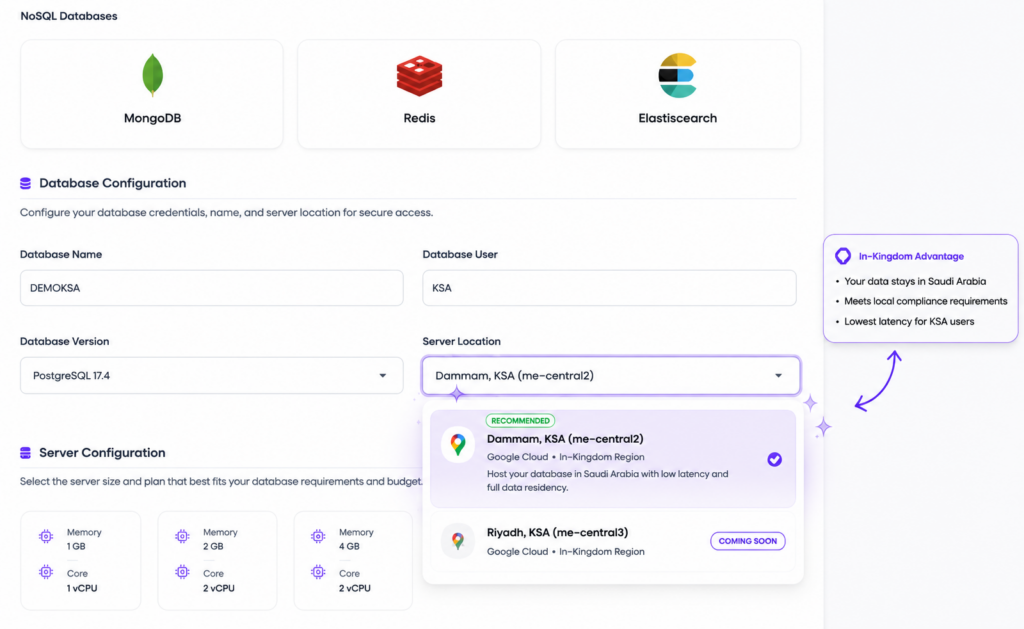
3. Make sure backups stay in-Kingdom
Here’s the copy that breaks residency most often. A backup is a full copy of your database. If it writes to a bucket in another country, your data now lives in two places, one of them outside the Kingdom, silently. Automatic backups are the safety net; the destination region is what decides residency. Check that backups land in the same Dammam region as the primary. On a managed setup that check takes a minute; skipping it can cost you a deal.
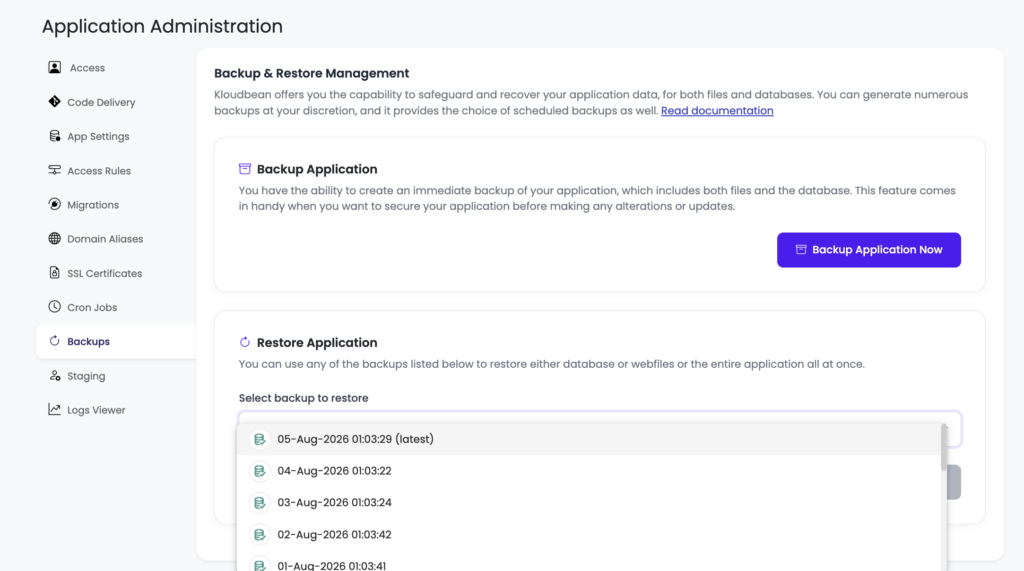
4. Watch the third parties and the CDN edge
This one is sneakiest: it lives outside your server. Every service you forward data to has its own residency: a payment processor, an email sender, an analytics tool, an LLM API. Your residency is only as tight as those vendors. A CDN is the same story (great for public assets, a leak if it caches personal responses). Map them before someone asks. In-Kingdom infrastructure with a US analytics pipeline bolted on is not in-Kingdom data.
You don’t need a Google Cloud account
One misconception is that deploying into Google Cloud’s Dammam region means opening a Google Cloud account, configuring billing, managing IAM permissions, creating networks, launching virtual machines, installing operating systems, and securing everything yourself.
With KloudBean, none of that is necessary.
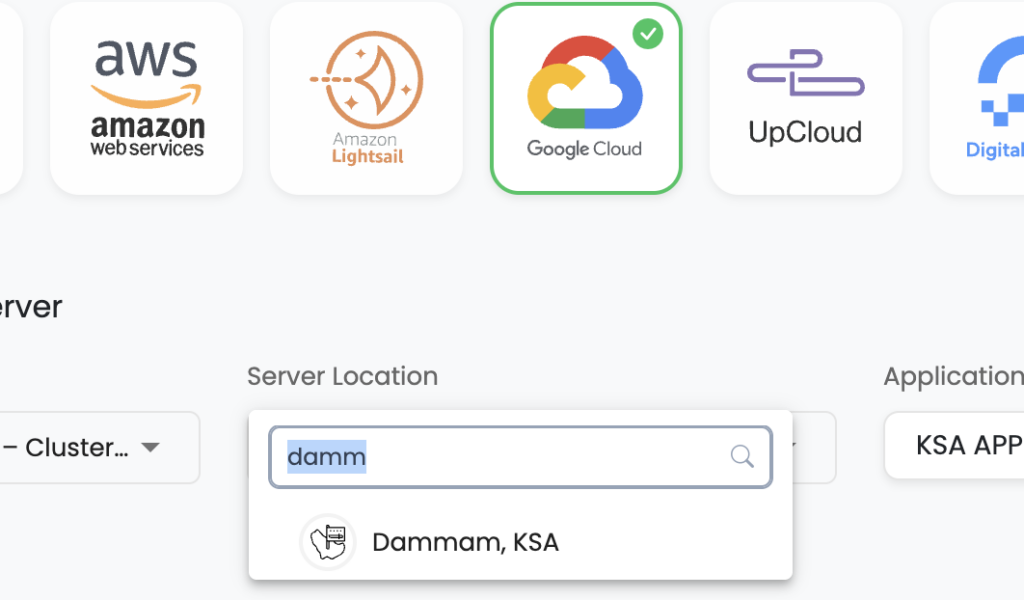
Choose Google Cloud → Dammam (me-central2) from the dashboard, pick your server size, and launch. KloudBean provisions the infrastructure, secures it, configures backups, installs SSL, and manages the operating system while your application runs inside Google Cloud’s Saudi Arabia region.
The result is the same infrastructure without the operational complexity.
Built for Enterprise Workloads
Many Saudi deployments are more than a single application.
Production environments often require:
- Load Balancers
- Multiple application servers
- Managed databases
- Virtual Private Cloud (VPC)
- Object storage
- Dedicated support
- Disaster recovery
KloudBean Enterprise supports custom infrastructure designed around these requirements while keeping the entire deployment inside the selected Saudi region.
Disaster recovery isn’t optional especially for enterprise workloads
For many organizations, keeping data inside Saudi Arabia is only half the requirement. The other half is proving that services can recover when something goes wrong. Hardware fails. Storage can become corrupted. Applications can be deployed incorrectly. Entire virtual machines can be lost. A disaster recovery plan exists so none of those events become a business disaster.
A proper DR strategy starts by separating production from recovery. Your live application should never be the only copy of your business. Databases need scheduled backups, uploaded files need durable object storage, application code should live in version control, and the recovery procedure should be tested—not simply documented.
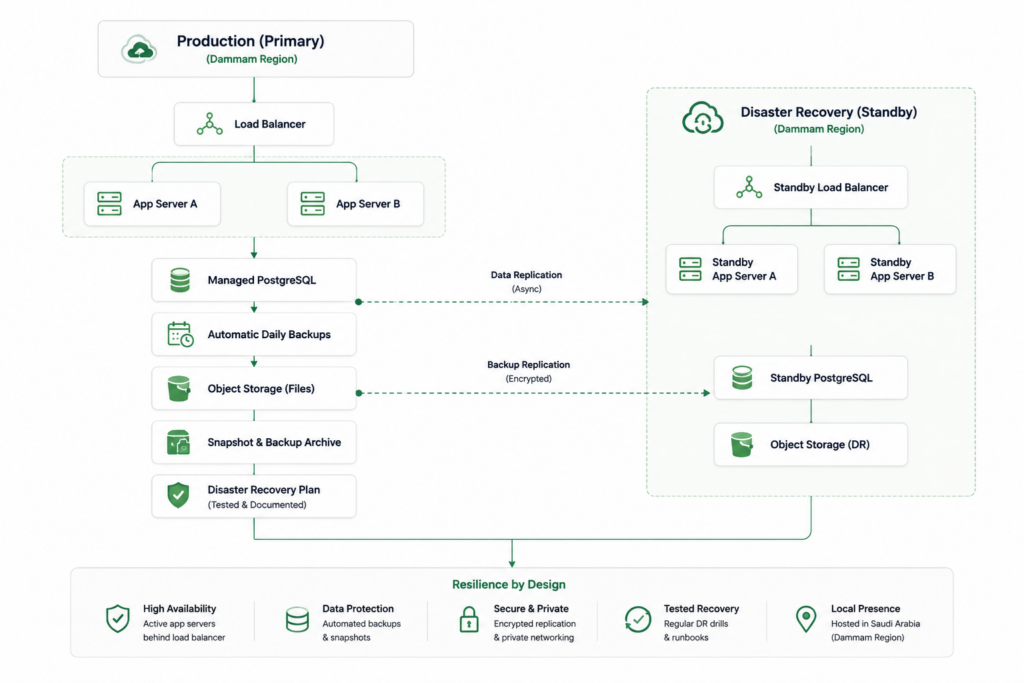
KloudBean is designed so every layer of that recovery plan can be managed from one place. Automatic server snapshots, managed database backups, object storage, SSL certificates, application deployments, and infrastructure management all remain under the same dashboard, making it much easier to rebuild an environment if recovery is ever required. Rather than manually piecing together servers, databases, storage, and networking from multiple providers, the infrastructure can be recreated in a structured and repeatable way.
For organizations with stricter business continuity requirements, enterprise deployments can extend this further with dedicated infrastructure, backup policies, private networking, load balancers, and custom recovery architectures designed around Recovery Time Objectives (RTO) and Recovery Point Objectives (RPO). Every organization’s requirements are different, but the objective remains the same: recovery should be planned before an incident, not during one.
The important point is that disaster recovery isn’t a separate product you think about later. It becomes part of the infrastructure from the day your application is launched.
One dashboard for the entire stack
Running production infrastructure eventually becomes less about servers and more about everything surrounding them. Applications need databases, object storage, SSL certificates, backups, monitoring, users, deployment tools, and sometimes load balancers or automation services. Managing each of those from a different provider quickly turns into an operational problem of its own.
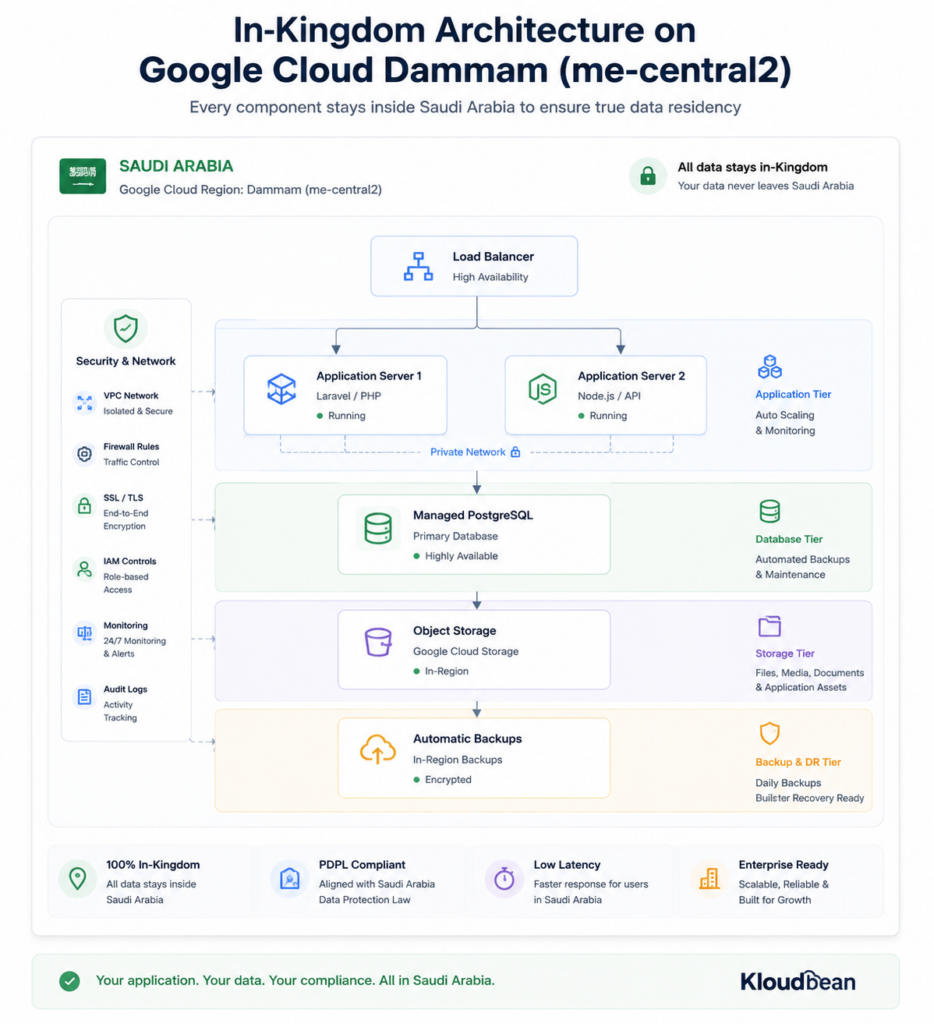
KloudBean brings these services together under a single dashboard. Servers, managed databases, object storage, applications, AI tools, backups, monitoring, SSL certificates, user management, and networking can all be managed from one place while the infrastructure itself continues running on major cloud providers. Instead of switching between multiple cloud consoles every day, the operational experience stays consistent regardless of what you’re deploying.
Object storage deserves the same residency check
Databases usually receive most of the attention during residency reviews, but uploaded files deserve exactly the same scrutiny. Images, invoices, contracts, customer documents, videos, application uploads, and generated reports often live in object storage rather than inside the database itself. If those files are stored outside Saudi Arabia, part of your application’s data has already left the Kingdom.
The safest approach is to create object storage in the same region as the application and database from the beginning. KloudBean lets you provision managed object storage alongside your servers, applications, and managed databases, making it straightforward to keep uploaded content inside the same Google Cloud Dammam (me-central2) region. Whether you’re using Laravel’s filesystem driver, Django’s storage backends, WordPress media offloading plugins, or another framework with Google Cloud Storage support, the goal remains the same: every uploaded file stays in the same region as the rest of your application.
Where in-Kingdom data quietly leaks out
Teams rarely fail residency at the server. They fail it at the copies. Two anti-patterns account for most of it, both invisible until an auditor or a customer looks.
The backup that left the country. You launch in Dammam, feel done, and never check where backups write. Months later a security questionnaire asks for your backup location, and you find the nightly snapshot has been landing in a global bucket in Europe. The primary was in-Kingdom. The copies were not. On paper your data left Saudi Arabia every night at 2am. Fixing it later means re-pointing backups and explaining the gap. Far cheaper to check on day one.
The CDN that cached personal data. A CDN in front of your site is great for a public landing page. But switch on aggressive caching without thinking, and it can start holding authenticated, personal responses (an account page, an order confirmation) at edge nodes in dozens of countries. Now copies of Saudi residents’ data sit on servers worldwide, the exact thing residency was meant to prevent. The mistake is never checking where those copies land. Cache public assets at the edge; keep personal, authenticated responses on your in-Kingdom origin.
How to verify your data is really in-Kingdom
Residency you can’t prove is residency you don’t really have. When a procurement team asks “where is my data stored?”, the answer needs evidence, not a shrug. Here’s the check I’d run before signing anything, and again on a schedule: walk each copy of your data and confirm its region. The table below is the whole audit.
| Copy of your data | How to confirm it’s in-Kingdom | Where it silently escapes |
|---|---|---|
| Application server | Region label reads Dammam (me-central2) in the console | A “Middle East” label that’s actually Bahrain, the UAE, or an EU region |
| Managed database | Launched in the same Dammam region, on the private network | Left in a default region while only the app moved in-Kingdom |
| Backups | Backup destination shows the same Dammam region | Snapshots defaulting to a global or nearest-region bucket abroad |
| Object storage / uploads | Bucket region set to Dammam | A bucket created in a us or eu default without noticing |
| CDN cache | Only public, static assets cached at the edge | Authenticated or personal responses cached at worldwide edges |
| Logs and analytics | Log sink and analytics store in-region, or carry no personal data | Request logs with IPs and emails shipped to a US SaaS |
| Third-party APIs | Each vendor’s data region documented and in scope | Payment, email, or LLM APIs processing personal data abroad |
It takes an afternoon the first time, minutes on each re-check. The payoff is a straight answer with receipts: server, database, and backup regions, plus a short list of vendors and their data locations. That one-page document beats any amount of “trust us” in a Saudi security review.
Vendor Security Questionnaire
Customer Data & Infrastructure
| Question | Response | Details |
|---|---|---|
|
Where is customer data stored?
|
Dammam, Saudi Arabia | All customer data is stored in our Dammam (me-central2) region. |
|
Is data encrypted at rest?
|
Yes | All data is encrypted using AES-256 encryption. |
|
Is data encrypted in transit?
|
Yes | All data in transit is protected using TLS 1.2+ protocols. |
|
Do you have a backup strategy?
|
Yes | Automated daily backups with cross-zone redundancy. |
|
Do you store data outside the declared region?
|
No | Customer data does not leave the declared region. |
|
Who has access to the data?
|
Authorized Personnel Only | Access is role-based and limited to authorized personnel. |
What residency does not cover: PDPL is bigger than location
Now the honest boundary, because overclaiming here is how trust dies. Hosting in the Kingdom settles where your data lives. It does not make you “PDPL compliant” on its own, and no host can hand you that. PDPL is broader than residency: lawful basis, consent, retention, user disclosures, and data-subject requests. All of that is app-level work you own, wherever the servers sit.
The clean way to think about it is shared responsibility. The platform provides the infrastructure controls: the in-Kingdom region, the private network, automatic backups, baseline firewalling with Shorewall and Fail2ban, access control. You own the data practices on top. Kloudbean makes no certification claim on your behalf; be wary of any host that says hosting alone makes you compliant. The same shared-responsibility logic runs through GDPR-compliant hosting and maps cleanly onto PDPL; for the Saudi-specific angle, see PDPL compliance hosting. Treat this as a map, not legal advice, and confirm the details with someone qualified for a high-stakes tender.
My honest read after watching a lot of these reviews: most Saudi-facing teams don’t need an exotic sovereign-cloud contract. They need their data physically in the Kingdom and a documented answer for procurement. Two different jobs, and the second is solved by the first plus a habit of verifying the copies.
The real goal isn’t Saudi hosting. It’s confidence.
By the time someone asks where your customer data lives, it’s usually too late to start moving infrastructure. Procurement teams, security reviewers, enterprise customers, and government organizations expect a clear answer backed by documentation, not assumptions.
The good news is that building for data residency doesn’t have to be complicated. Choose the correct region from day one, keep your application, database, object storage, and backups together, and periodically verify that nothing has drifted outside the Kingdom. That’s far easier than redesigning an entire production environment after launch.
For organizations that need stronger business continuity, the same planning naturally extends into disaster recovery. Applications, databases, uploaded files, infrastructure configuration, and backups should all be recoverable through a documented process. A residency strategy is strongest when it doesn’t just answer “Where is our data?”, but also “How do we recover if something fails?”
KloudBean was built around that philosophy. From a single dashboard you can provision applications, managed databases, object storage, networking, SSL certificates, automatic backups, and enterprise infrastructure on Google Cloud’s Dammam (me-central2) region without managing the underlying cloud platform yourself. Whether you’re launching a single application or a larger production environment, the objective stays the same: keep your infrastructure inside the Kingdom, keep it manageable, and make recovery part of the design rather than an afterthought.
FAQ
How do I guarantee my data stays inside Saudi Arabia?
Launch on an in-Kingdom region and keep every copy there. On Kloudbean that’s Google Cloud’s Dammam (me-central2): pin the server to it, launch the managed database in the same region, and confirm backups write in-region. Then check the copies that move quietly, your CDN cache, logs, and any third-party service you send data to.
What is the difference between data residency and data sovereignty in Saudi Arabia?
Data residency is where your data physically sits. Data sovereignty is the legal result: whichever country holds the data, its laws apply, so data in Saudi Arabia falls under Saudi law including the PDPL. Picking the Dammam region also picks Saudi jurisdiction; you don’t choose them separately.
Which region keeps my data inside Saudi Arabia?
On Kloudbean, it’s Google Cloud’s Dammam region, code-named me-central2, physically inside Saudi Arabia. That’s the in-Kingdom option among Kloudbean’s clouds. Regions marketed as “Middle East” sometimes sit outside the country, so confirm the exact region label.
Do backups affect data residency in Saudi Arabia?
Yes, and this is the most common leak. A backup is a full copy of your data, so if snapshots write to a bucket in another country, your data now lives outside the Kingdom too. Confirm the backup destination is the same Dammam region as your primary database, and keep it there.
Can a CDN break in-Kingdom data residency?
It can. A CDN caches copies of your content at edge nodes worldwide, which is fine for public, static assets. It becomes a residency problem if you let it cache authenticated or personal responses, because copies of Saudi residents’ data then spread across many countries. Cache public assets; keep personal responses on your in-Kingdom origin.
Does hosting in Saudi Arabia make me PDPL compliant?
No. Hosting in the Dammam region settles the location question, a real and hard-to-retrofit part of PDPL, but not the whole law. You still own lawful basis, consent, retention, disclosures, and data-subject rights at the application level. Compliance is shared: the platform provides infrastructure controls, you own the data practices.
How do I prove to a procurement team that my data is in-Kingdom?
Document each copy and its region: the server, the database, the backups, object storage, and every third-party vendor you forward data to. Confirm each reads Dammam (me-central2) or is otherwise in scope. A short one-page residency summary answers “where is my data stored?” far better than a verbal assurance.
Does Kloudbean own a data center in Saudi Arabia?
No, and be wary of any managed host that claims to. Kloudbean provisions and fully manages your stack on top of major cloud providers, and the in-Kingdom capability comes from Google Cloud’s Dammam region (me-central2). Its job is to run, secure, and back up your server and database in that region.
Where is my data stored if I don’t choose a region?
It lands in whatever the default is, often a US or EU region, not Saudi Arabia. That’s how teams end up hosting a Saudi audience abroad by accident. Because you pick the cloud and region at launch, in-Kingdom residency is a deliberate choice, not something that happens by default.
Kloudbean MENA · In-Kingdom by choice, verified by habit.