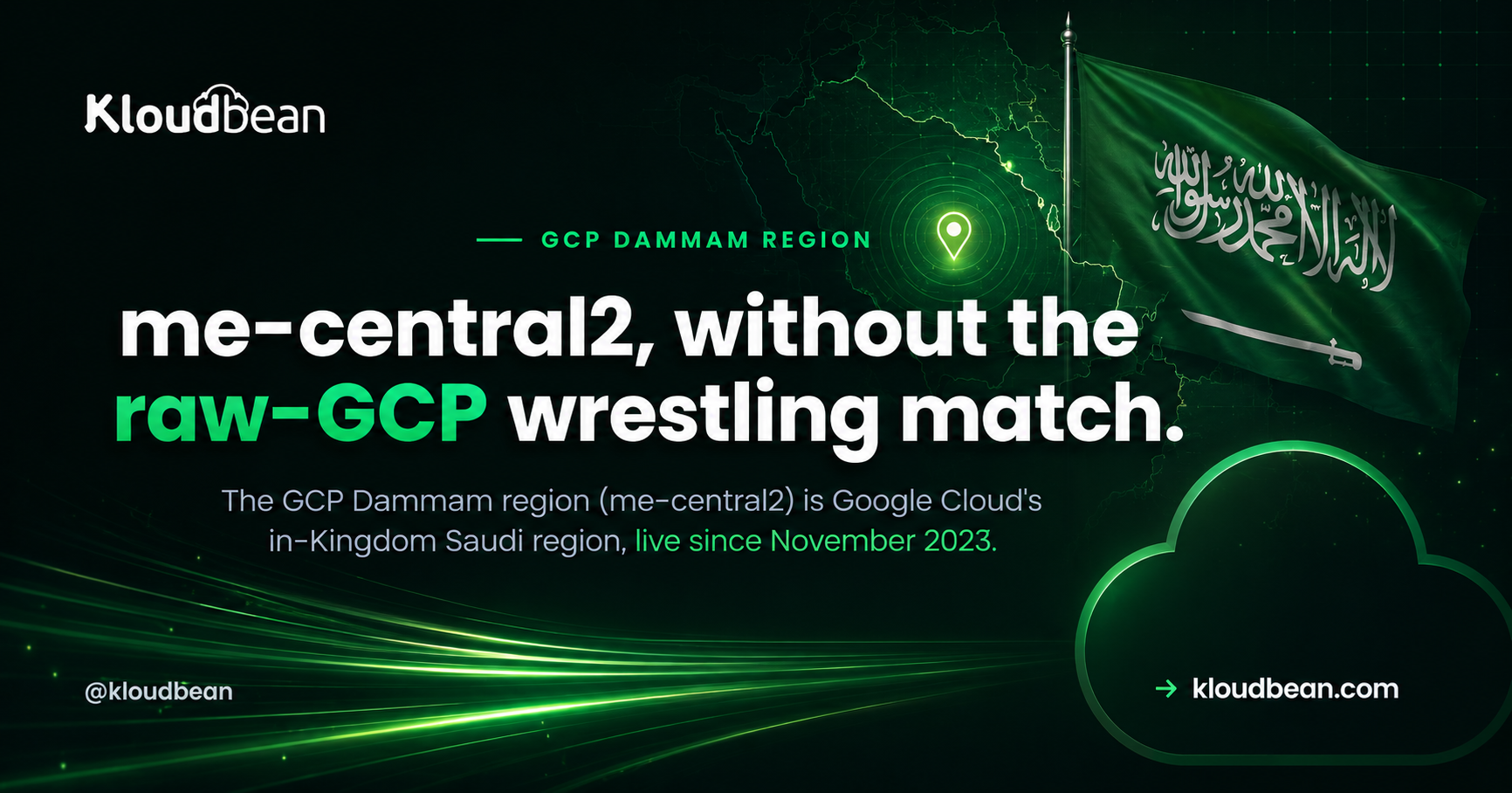
If your users, your auditors, or a government tender need your data physically inside Saudi Arabia, the GCP Dammam region is the name to know. It’s Google Cloud’s in-Kingdom Saudi region, code me-central2, live since November 2023. This guide is the technical version: what a cloud region and its zones actually are, what me-central2 means for latency and data residency, and how you launch on it through a managed platform without ever opening the raw Google Cloud console. Short version, you pick Dammam at launch and the rest is handled.
The Dammam region (me-central2) is Google Cloud’s data center region physically inside Saudi Arabia, launched in November 2023. It’s the in-Kingdom option among Kloudbean’s seven clouds. You use it by picking it when you add a server. Kloudbean then provisions and manages your server, database, and backups in that region, so your stack sits on Saudi soil and you never touch raw GCP or its projects, IAM, and reseller billing yourself.
What is the GCP Dammam region (me-central2)?
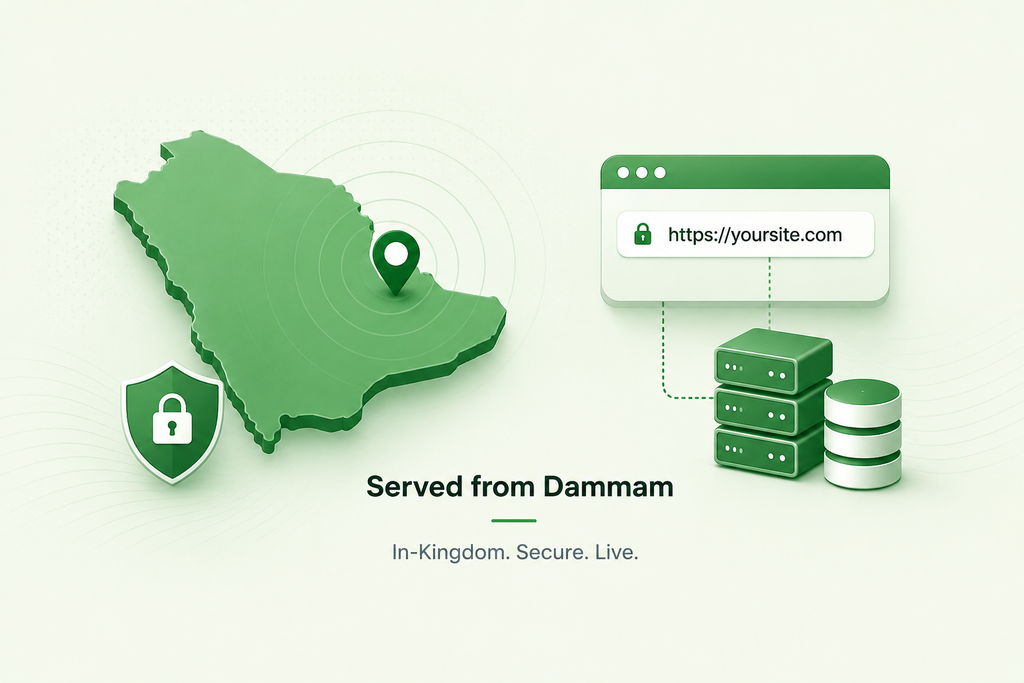
The Dammam region is a full Google Cloud region located in Saudi Arabia’s Eastern Province. Google gave it the code me-central2, which reads as “Middle East Central 2,” and it went live in November 2023. Being a full region means it carries the usual Google Cloud building blocks: compute, storage, networking, and managed databases, in-country.
Two things people mix up are worth pinning down early. First, Google Cloud operates the Dammam data center, not Kloudbean. The in-Kingdom capability you get through Kloudbean comes from provisioning and fully managing your stack on top of Google’s me-central2 region. Second, it isn’t the country’s sole cloud region. Other providers run Saudi regions too, so me-central2 is best described as the in-Kingdom option inside Kloudbean’s cloud lineup, not the country’s single data center. If the whole idea of a “region” is fuzzy, the ground-up version lives in how cloud hosting works.
One more grounded detail, because it explains a lot of the friction people hit with raw GCP in the Kingdom. Google sells Google Cloud in Saudi Arabia through a local exclusive reseller called CNTXT. If you have a Saudi billing address and buy Google Cloud services standalone, including anything in the Dammam region, that purchase routes through the reseller. More on that below.
Regions and zones, in plain terms
A cloud region is a physical cluster of data centers in one geographic area. me-central2 is the Dammam region. When you place a workload “in a region,” you’re choosing the patch of the planet the machines physically sit on. That single choice is what decides residency and sets your latency floor.
Inside a region are zones. A zone is an isolated failure domain: its own power, cooling, and networking, engineered so a problem in one zone shouldn’t drag down the others. A Google Cloud region usually has three zones, and they’re named after the region with a letter suffix. So the Dammam region’s zones look like this:
Region:  me-central2        (Dammam, Saudi Arabia)
Zones:   me-central2-a
         me-central2-b
         me-central2-c
Why does the split matter? Resilience. Spread a serious workload across zones and one can fail without taking your whole app down. A single managed server usually lives in one zone, which is fine for most apps. The important part: every zone in me-central2 is inside Saudi Arabia, so your zone choice never sends data across a border. Region is the decision that counts; zones are how it stays reliable underneath you.
What me-central2 means for latency
Distance is physics, not a setting you can tune. Every request from a browser is a round trip, and the speed of light through fiber puts a hard floor under how fast that trip can be. Serve a Riyadh user from a European region roughly 4,000 km away and that floor lands in the tens of milliseconds per trip. In practice it’s often 90 to 130 ms. Serve the same user from the Dammam region and the trip is domestic, so the floor mostly disappears.
Geography adds a fair caveat. Dammam sits in the Eastern Province, close to Riyadh (roughly 400 km). Jeddah is on the Red Sea coast, over a thousand kilometers west, so it sees a smaller improvement than Riyadh, though still large against Europe. These are physics floors, hedged, not a Kloudbean benchmark or an SLA. If latency is the thing you actually care about, the deep version with measurement commands lives in low latency hosting for Riyadh and Jeddah.
What me-central2 means for data residency
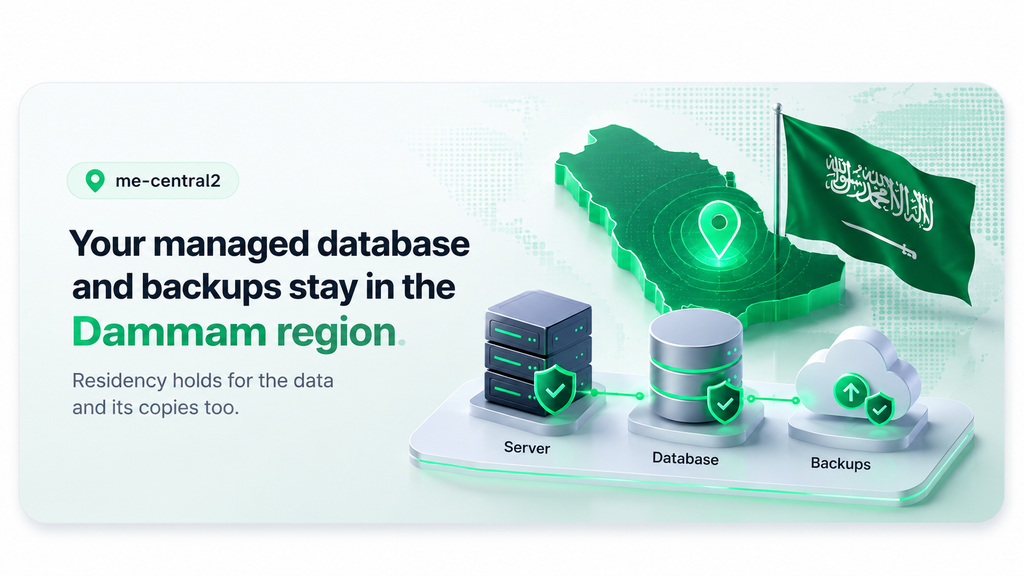
Because the Dammam region is physically in Saudi Arabia, putting your workload there is what makes your data resident in-Kingdom. On a managed setup that means the whole stack stays put: the server, the managed database beside it, and the backups all live in me-central2. That last one trips people up. A backup quietly written to another country undoes your residency, so keeping copies in-region matters as much as the primary.
Be careful with the compliance leap, though. Hosting in the Kingdom is a strong, real base for the location parts of PDPL and the NCA’s controls, but it isn’t a certificate and it doesn’t finish the job by itself. Consent, lawful basis, retention, and data-subject rights stay your responsibility at the application layer. That’s the shared-responsibility model. For the KSA-specific how-to-guarantee-and-verify version, see data residency in Saudi Arabia. For the plain-English concept, data residency explained covers residency versus sovereignty without the regional detail.
Raw GCP versus a managed path to the Dammam region
You can reach me-central2 two ways: stand it up yourself in the raw Google Cloud console, or let a managed platform provision and run it for you. Both put your bytes in Dammam. They are not the same amount of work.
| What you deal with | Raw GCP (me-central2 direct) | Managed path (Kloudbean on me-central2) |
|---|---|---|
| Getting billing set up | Saudi billing routes through the local reseller (CNTXT); you contract and pay through them | One Kloudbean signup; you pick the region and go |
| Provisioning | Projects, IAM roles, VPC, subnets, firewall rules, compute, disks, all by hand | Choose Google Cloud and the Dammam region; the server is built for you |
| OS and stack | You install and patch the OS, web server, runtime, and database yourself | Server, stack, and patching handled; you deploy your app |
| Backups and SSL | You configure snapshots, backup storage, and certificates | Automatic backups in-region and free auto-renewing SSL |
| Day-two operations | Several Google Cloud consoles and your own tooling | Server, database, storage, SSL, and backups under one dashboard |
My honest take after watching plenty of these builds: for most teams the managed path wins. If you’re a bank or a government body with a dedicated cloud team and a mandate to own every IAM policy, going direct makes sense. But a startup, an agency, or a SaaS that simply needs its data in Dammam and a clean answer for procurement does not benefit from hand-rolling GCP projects and reseller billing. You benefit from picking a region and shipping. If you’re weighing options, how to choose managed cloud hosting lays out the criteria that actually matter.
How to launch in the Dammam region on Kloudbean
The setup is short, because the hard part is a single click. From empty account to a running, in-Kingdom stack:
- Add a server and pick the Dammam region. Choose Google Cloud, then the Dammam (me-central2), Saudi Arabia region. Size it for your workload; you can resize later as traffic grows. This one choice pins your residency and sets your latency floor.
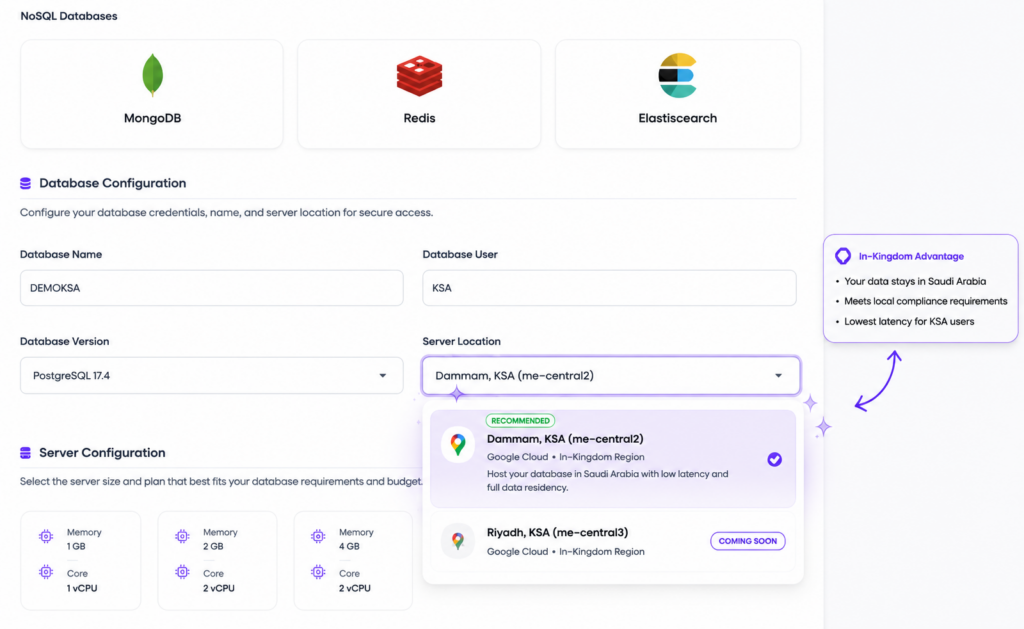
- Launch a managed database in the same region. Create a managed engine (PostgreSQL, MySQL, Redis, and more) and it provisions right beside your app, locked to your app server’s IP, backed up automatically, all inside the Kingdom.
- Deploy your app and turn on free SSL. Point a domain at the server and issue an auto-renewing certificate. HTTPS becomes one step instead of a recurring chore.
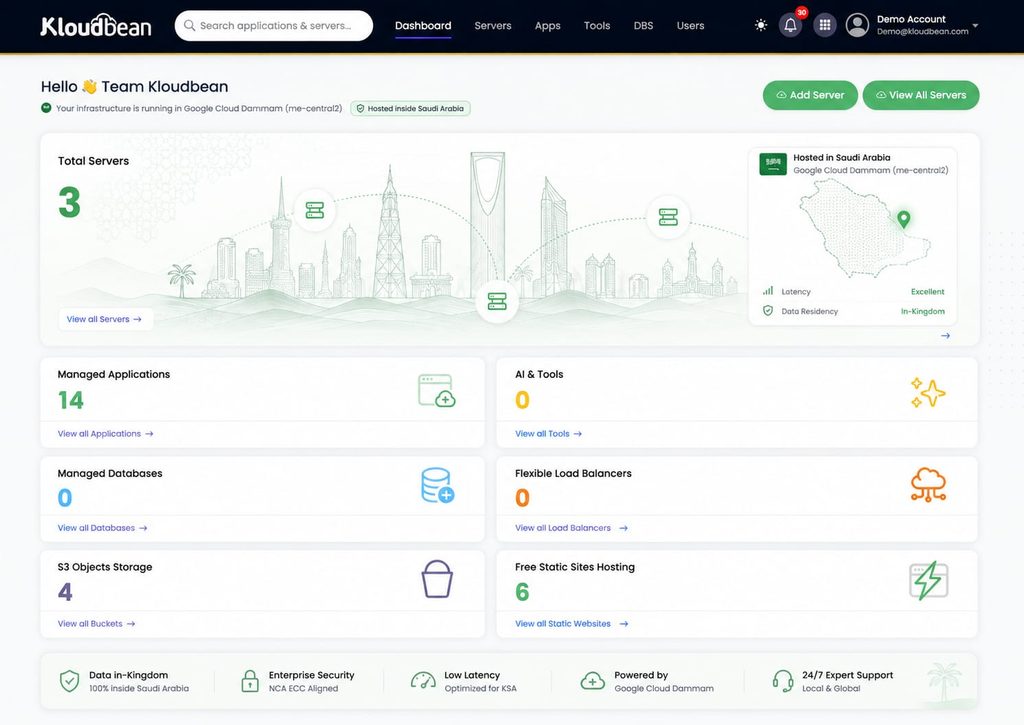
- Run the whole stack from one dashboard. Server, database, storage, SSL, and backups sit under a single login, which makes “where does this run” an easy question for an auditor.
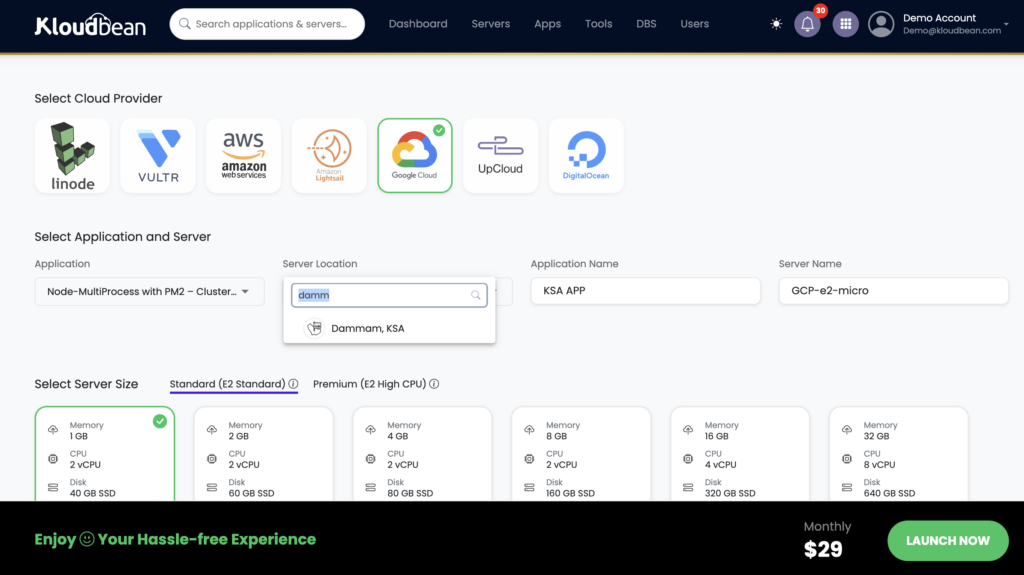
The database step is worth doing at launch, so it lands in the same region from the start. The full pattern, connection strings and migrations included, is in how to add a managed database to your app. In-Kingdom, the steps are identical; you’ve just pinned the region to Dammam first.
Common mistakes with the Dammam region
Most region mistakes aren’t exotic. They’re small defaults that quietly cost you the thing you moved to Dammam for:
- App in Dammam, database in a default US or EU region. Your server is in-Kingdom but the managed database it queries all day still sits in the console’s default region. Now every query pays the full cross-continent round trip, and your personal data left the country. Put the database in me-central2 too.
- Trusting a “Middle East” label. Regions marketed as regional often sit outside the country. me-central2 is specific and checkable; a vague label is not. Confirm the exact region, not the marketing.
- Assuming region equals compliance. Dammam settles the location question. It does not hand you a PDPL certificate or finish your app-level controls. Treat residency as the foundation, not the whole building.
- Letting backups drift. A backup written to another region silently breaks residency. Keep copies in me-central2 with the primary.
Where this fits, and the edges
To keep it honest, here are the boundaries. Google Cloud operates the Dammam data center region; Kloudbean provisions and fully manages your stack on top of it, and does not own a data center in Saudi Arabia. Kloudbean runs Linux stacks (PHP, Node, Python, Ruby, Java, and their databases), not Windows or .NET. “Managed” means the platform handles the server, stack, SSL, backups, and patching, while your application code and data stay yours to export whenever you want.
And me-central2 is the in-Kingdom choice among Kloudbean’s seven clouds, not the only Saudi region out there. If your audience and obligations are global, Dammam is a tiebreaker rather than a requirement. If they’re Saudi, it’s usually the first decision you make, and it’s a single click at launch. For the buyer’s-guide framing of that decision, start at the pillar: cloud hosting in Saudi Arabia.
Deploy in Dammam. Skip the GCP complexity.
Launch on Google Cloud’s Dammam region (me-central2) while managing your servers, databases and backups from one simple dashboard.
FAQ
What is the GCP Dammam region (me-central2)?
It’s Google Cloud’s data center region physically located in Dammam, Saudi Arabia, with the region code me-central2. It provides the standard Google Cloud building blocks (compute, storage, networking, databases) inside the Kingdom. On Kloudbean it’s the in-Kingdom region you pick when adding a server, so your workload sits on Saudi soil.
When did the Google Cloud Saudi Arabia region launch?
Google Cloud opened its Dammam region in Saudi Arabia in November 2023. Since then it has kept adding sovereign, security, and AI capabilities to me-central2. It’s a fairly young region compared with Google’s older European and US regions, but it’s a full, production region.
Does Kloudbean own the Dammam data center?
No, and be wary of any managed host that claims to. Google Cloud operates the Dammam region. Kloudbean provisions and fully manages your server, database, and backups on top of me-central2, which is how you get an in-Kingdom stack without running the raw cloud yourself.
What is the difference between a region and a zone?
A region is a geographic cluster of data centers, like me-central2 in Dammam. A zone is an isolated failure domain inside that region, with its own power and networking. You choose a region for residency and latency; zones exist so a workload can survive one data center having a bad day.
How many zones does me-central2 have?
The Dammam region has three zones, named me-central2-a, me-central2-b, and me-central2-c, which is the typical shape for a Google Cloud region. A single managed server usually lives in one zone. Every zone in me-central2 is inside Saudi Arabia, so your zone choice never crosses a border.
Do I have to deal with CNTXT to use the Dammam region?
If you buy Google Cloud directly with a Saudi billing address, standalone purchases (me-central2 included) route through Google’s local exclusive reseller, CNTXT. That’s a normal part of the market. When you provision the region through a managed platform instead, that reseller billing and contracting is handled for you, which is a big reason teams take the managed path.
Does hosting in Dammam make me PDPL compliant?
Not on its own. Hosting in me-central2 gives you a strong base for the location parts of PDPL and the NCA’s controls, but compliance is shared responsibility. You still own consent, lawful basis, retention, and data-subject rights at the application layer. Residency is the foundation, not a certificate.
How much faster is Dammam for Riyadh and Jeddah users?
Serving Saudi users from Europe puts a physical floor of tens of milliseconds on every round trip, often 90 to 130 ms in practice. Serving from Dammam makes the trip domestic and mostly removes that floor. Riyadh (closer to Dammam) sees the biggest gain; Jeddah, farther west, sees a smaller but still large improvement. These are physics floors, not guarantees.
How do I launch a server in the Dammam region?
Add a server on Kloudbean, choose Google Cloud, then select the Dammam (me-central2), Saudi Arabia region. Launch a managed database into the same region, point your domain, and enable free SSL. Backups run automatically in-region, and everything sits under one dashboard.
Kloudbean MENA · Pick Dammam at launch, manage the rest from one dashboard.