Most Saudi businesses that need a server have no interest in becoming a server company. You run a store, an agency, a clinic’s booking system, or a SaaS for Riyadh clients. What you don’t have is a DevOps bench sitting idle, waiting to patch Linux at midnight. That gap is what managed hosting in KSA fills. Someone else runs the box, keeps it patched and backed up, and keeps it in-Kingdom, while your team ships. This is the honest version: what “managed” actually buys a Saudi team, what stays your job no matter who you pay, and when running it yourself is still the smarter move.
Managed hosting means the platform operates the server for you: provisioning, the stack, SSL, patching, backups, and health monitoring. You own the app and the data. On Kloudbean that managed server can sit in-Kingdom on Google Cloud’s Dammam region (me-central2), so a Saudi team gets the operations handled and the data on Saudi soil, all from one dashboard.
What does managed hosting in KSA actually cover?
Strip off the marketing and managed hosting is a division of labor. You rent the same class of Linux server you’d get anywhere. The difference is that a platform does the operating work on it instead of you. On a managed plan the provider provisions the machine, installs and maintains the stack (web server, runtime, database), issues and renews SSL, patches the OS, runs backups, and watches the server’s health. You log in to your application, not to a bare box that needs a weekend of setup before it serves a single request.
Here’s the line that matters most for a Saudi team. Managed changes who does the ops, never who owns the work. Your application code is yours. Your data is yours. Your users, your business logic, and the app-level compliance decisions stay with you. Managed cloud hosting in Saudi Arabia takes the plumbing off your plate. It does not take your product, and a good host will let you export everything the day you ask.
Managed hosting vs doing it yourself: the honest split for a Saudi team
The real choice isn’t managed hosting against some abstract ideal. It’s managed against you and two engineers doing it after hours. So let’s put the jobs side by side. Same Linux box underneath both columns. What changes is the name next to each chore.
| The job | Do it yourself (raw VPS) | Managed hosting (Kloudbean) |
|---|---|---|
| Provision + harden | You spin it up and lock it down | Launched and hardened for you |
| Install the stack | Web server, runtime, database, by hand | Preinstalled and configured |
| SSL certificates | You issue and renew, or it lapses | Free SSL, issued and auto-renewed |
| OS + security patching | You patch, or you stay exposed | Patched for you |
| Backups + restore | You script them, and test them | Automatic backups, kept in-region |
| Monitoring + on-call | Your phone rings at 2am | The infra side is watched for you |
| In-Kingdom setup | You research regions and pray you picked right | Pick GCP Dammam once, done |
| Your app + data | Yours | Still yours |
Read the last row twice. Ownership of your code and data never moves. You outsource the operations, not the thing you built.
My honest opinion, after watching a lot of small teams make this call: most Saudi SMEs and agencies have no business patching their own servers. Not because they can’t. Because every hour spent on apt upgrade and cert renewals is an hour not spent on the product or the client. The ops work on a DIY box is rarely hard. It’s relentless, it’s boring, and it never stops:
# the checklist that quietly becomes your problem on a raw VPS
sudo apt update && sudo apt upgrade -y   # OS + security patches
sudo certbot renew                        # before the cert expires
df -h                                     # is the disk about to fill up?
journalctl -u nginx --since "1 hour ago" # why did it 502?
And the failure mode we see over and over is dull and expensive. A small team spins up a cheap VPS in a Frankfurt region to save a few riyals. Months pass. Then a Saudi client asks where the data physically lives, and the same week the SSL certificate quietly lapses, so every visitor hits a browser wall reading NET::ERR_CERT_DATE_INVALID. Now you’re migrating a live database and chasing a certificate the night before a demo. Managed hosting exists so that particular night never happens. If you want the full fundamentals of this split, we wrote the deep version in managed vs unmanaged hosting.
Why managed and in-Kingdom belong together in KSA
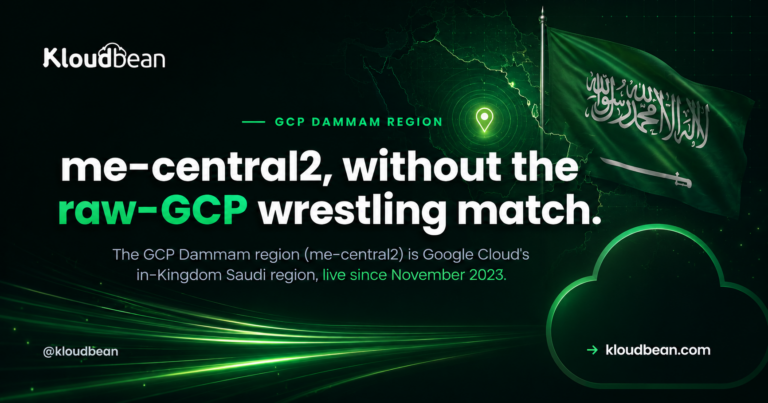
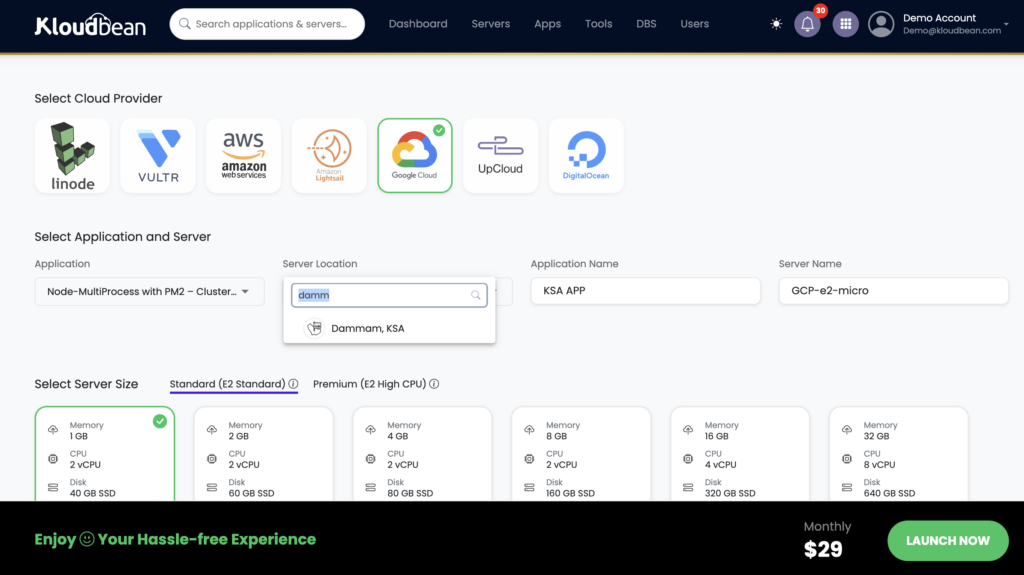
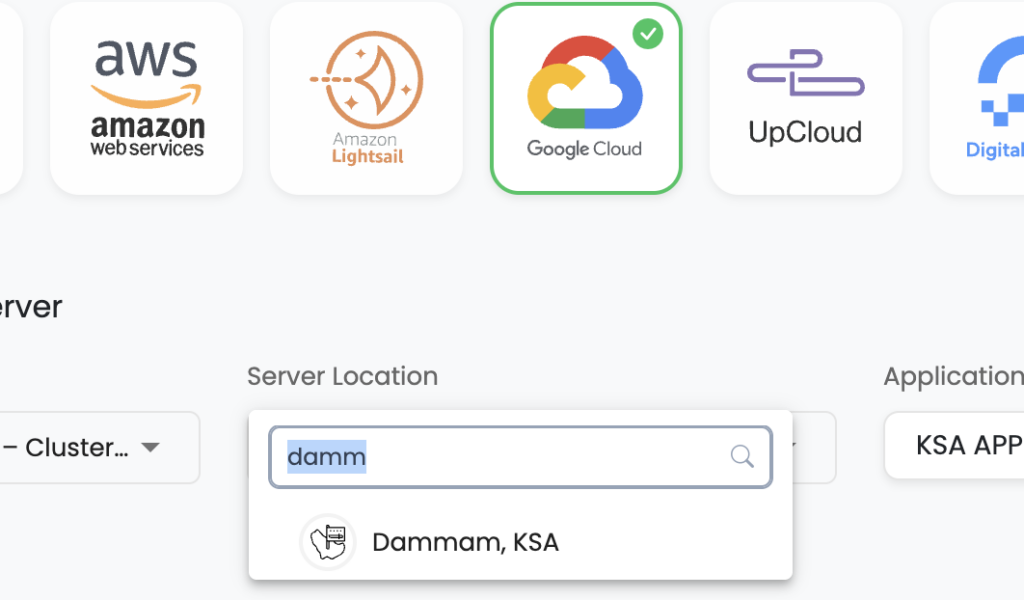
Plenty of hosts will run a server for you. Fewer will run it for you inside Saudi Arabia. That combination is the whole reason this article is KSA-specific rather than generic. Among the seven clouds Kloudbean provisions on (AWS, AWS Lightsail, Google Cloud, Linode, Vultr, DigitalOcean, and UpCloud), the one with a region physically inside the Kingdom is Google Cloud, through its Dammam region, code-named me-central2. Pick that region when you add a server and your managed stack lives on Saudi soil.
The screenshot below is the moment that decides it. Seven clouds on the left, and Google Cloud’s Dammam (me-central2), Saudi Arabia selectable as the in-Kingdom region. It’s a single click, and it happens once, at launch.
Managed makes that in-Kingdom promise real, not just a label on the app server. Because the platform runs the whole stack, the managed database launches into the same Dammam region and if you are looking forward to have security implements, for sure you can implemented as well like having VPC to VPN for whole of your infra. Free SSL is issued and auto-renews. And the automatic backups, which are the copies people most often forget, are taken and kept in the same region. That last detail matters more than it sounds. A backup that quietly lands in another country undoes your residency without anyone noticing. On a managed plan pinned to Dammam, the primary and its copies stay together, in-Kingdom.
Two things are worth being precise about, because marketing tends to blur them. Kloudbean does not own data centers in Saudi Arabia. The in-Kingdom capability comes from provisioning on Google Cloud’s Dammam region, one option among the seven clouds. And hosting in the Kingdom is a strong foundation for the residency and infrastructure parts of PDPL (the Personal Data Protection Law, overseen by SDAIA) and NCA ECC, but it is not a certificate and it does not do your app-level compliance for you. That’s shared responsibility, and the full picture lives in the pillar guide, cloud hosting in Saudi Arabia. For the residency specifics, see data residency in Saudi Arabia, and for the latency case to Riyadh and Jeddah users, low-latency hosting for Riyadh and Jeddah. But choosing where your application is hosted is also a data-sovereignty decision. With KloudBean, you can make that requirement straightforward by selecting Google Cloud’s Dammam region as your infrastructure location and keeping your workloads in the Kingdom from day one.
What happens when your application grows beyond one server?
A managed server is a good starting point, but production applications rarely stay that simple forever. A store adds a database, then Redis for caching, then object storage for customer uploads. A SaaS product adds background workers, scheduled jobs, an API server, and eventually a load balancer in front of multiple application servers. At that point, “where is my server?” is no longer the complete question. You need to know where the pieces that make the application work are running too.
This is where the difference between managed hosting and managed cloud infrastructure becomes important. KloudBean lets you build beyond the single-server model while keeping the infrastructure under the same dashboard. Your application can run on managed servers, your database can run as a managed service, files can live in object storage, and internal services can communicate over private networking. As the architecture grows, you don’t have to introduce a new cloud console for every new component.
The useful part for a Saudi team is that you can make the region decision at the infrastructure level rather than treating every component as a separate project. Start with a managed application server in Dammam, add the database it needs, add storage for uploaded files, and put the services behind the appropriate networking and load-balancing layer as the workload requires.
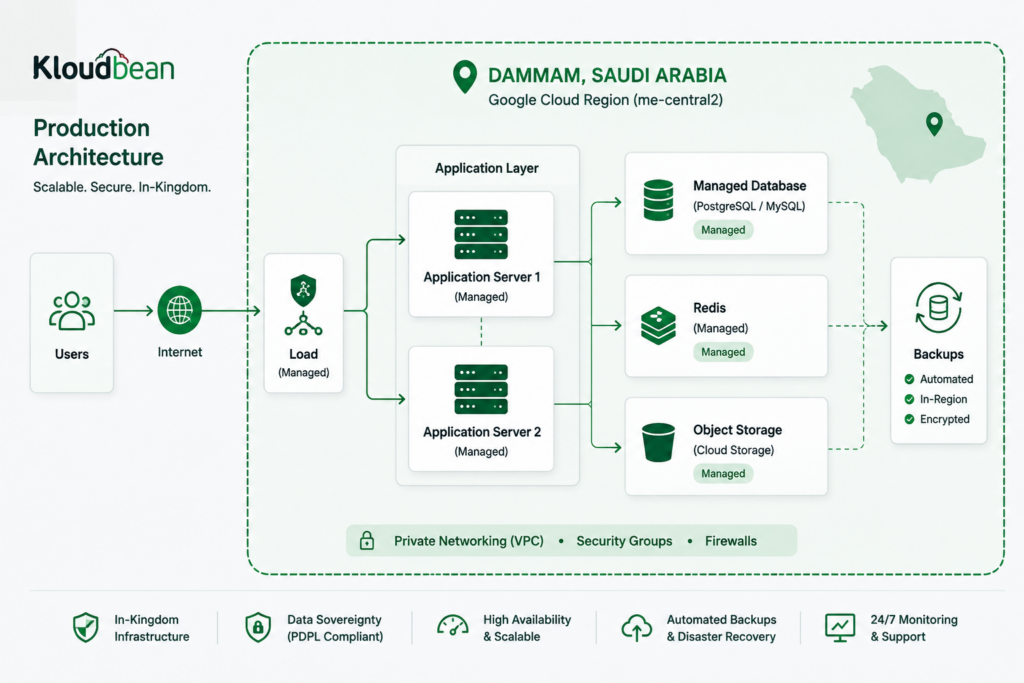
The important distinction is that managed hosting does not have to mean “one website on one VPS.” It can be the operational layer for a complete production application, while your team continues to own the code, data, users, and application decisions.
What can you actually run on managed infrastructure?
Managed hosting in Saudi Arabia should not be synonymous with WordPress hosting. WordPress is one workload, but modern Saudi businesses run everything from Laravel commerce platforms and Node.js APIs to Python applications, SaaS products, internal tools, automation workflows, and database-backed applications.
KloudBean supports a broad range of application workloads including PHP, WordPress, WooCommerce, Laravel, Node.js, Python, Django, Flask, Ruby and Java, along with the databases and supporting services those applications depend on. You can also use the platform for applications and tools such as n8n where the workload fits the supported environment.
That matters because the infrastructure decision shouldn’t force your application architecture into a particular programming language. Your Laravel application should not need to become WordPress simply because you’re looking for managed hosting in Saudi Arabia. Your Node.js API and your Python service should be able to live alongside the rest of your infrastructure.
The same principle applies to supporting services. Production applications may need Redis, managed databases, object storage, background workers, scheduled tasks, load balancers, and private networking. The infrastructure should accommodate those requirements rather than forcing you to stitch together unrelated services.
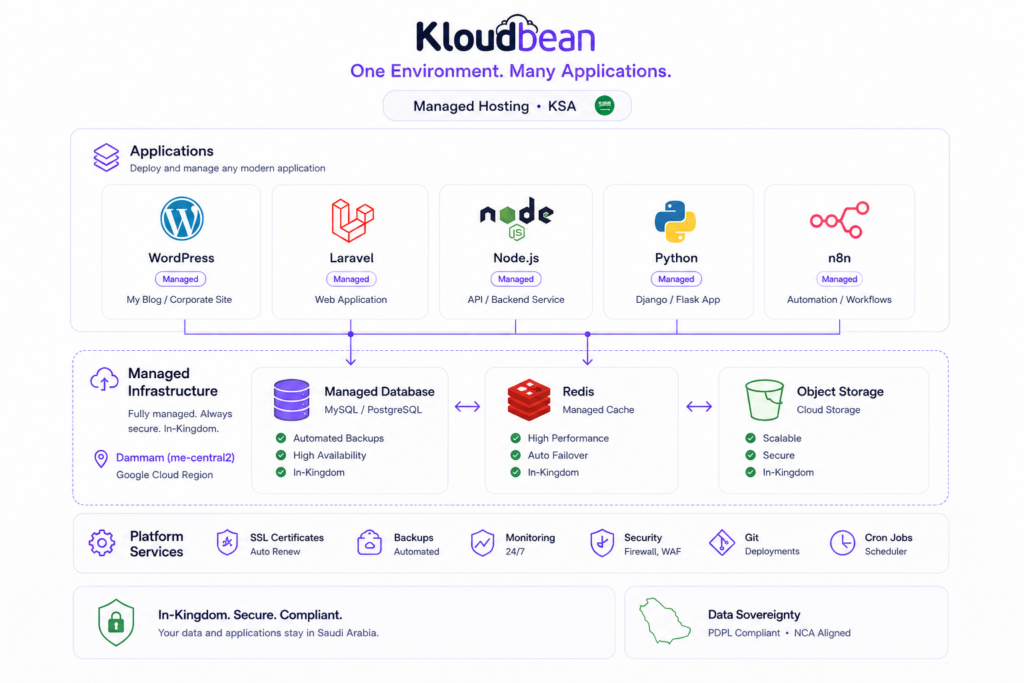
The result is a more useful definition of managed hosting: managed infrastructure for applications, rather than simply a managed website server.
What managed hosting looks like day to day
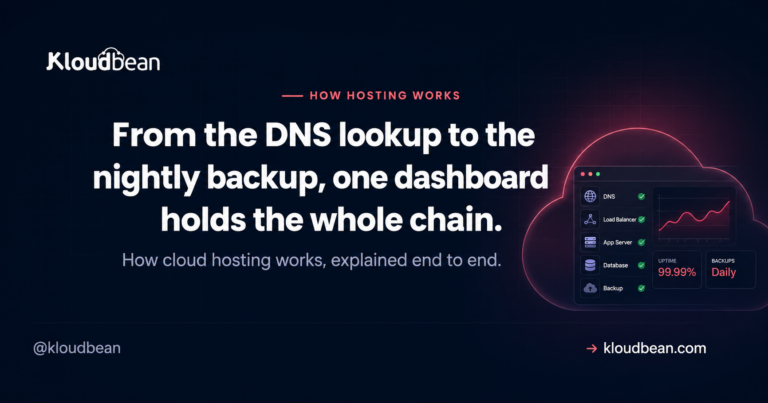
Once the server’s up, the daily experience of fully managed hosting in Riyadh or anywhere else in the Kingdom is mostly that you stop thinking about the server. You watch the whole stack from one dashboard: servers, applications, managed databases, storage, SSL, and backups, all under one login. No juggling a cloud console, a separate database service, and a certificate provider.
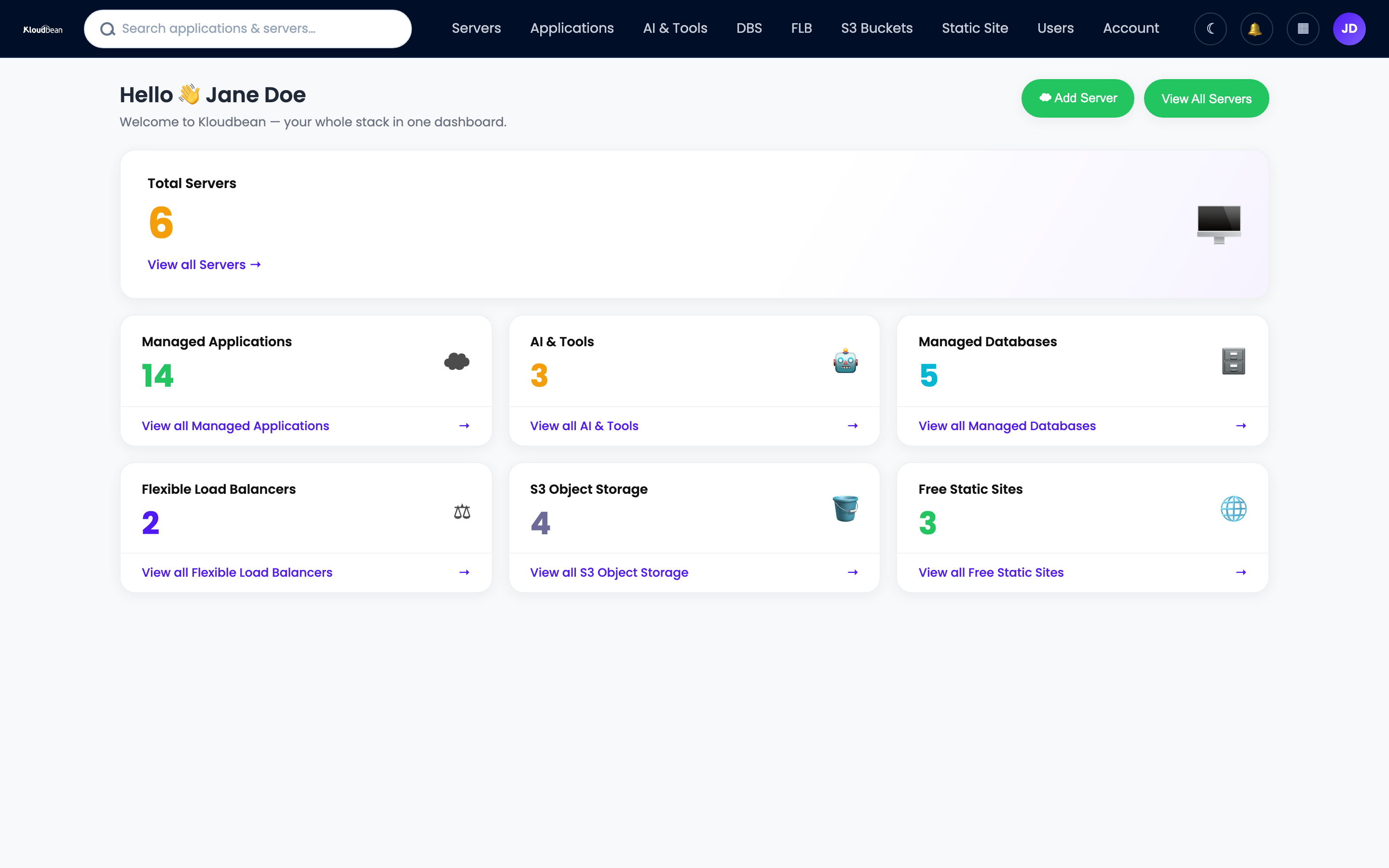
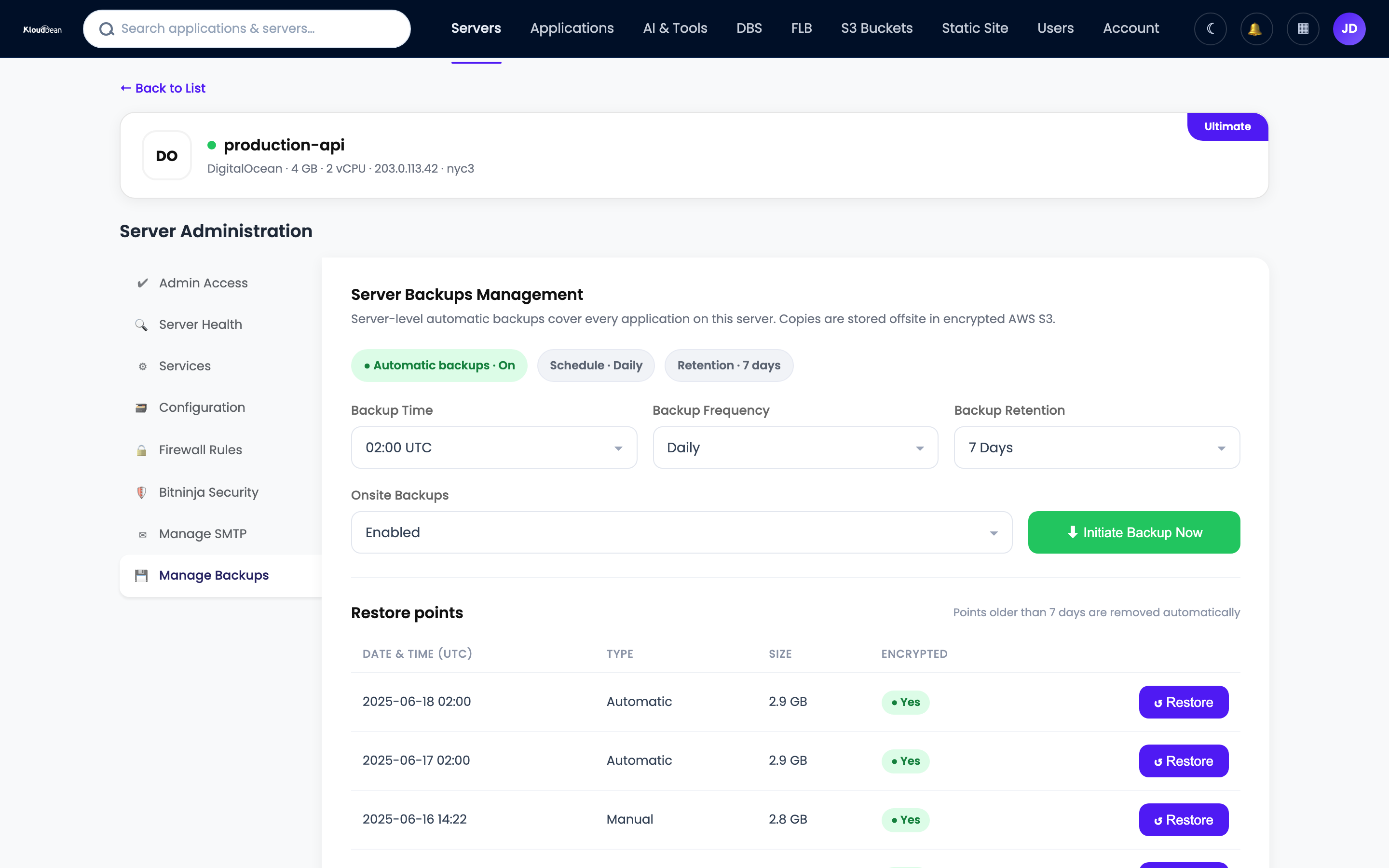
The parts that used to be a chore become settings. Backups run on a schedule you can see and adjust, and you can restore from the same screen. Do go test a restore before you need one. That’s the step everybody skips, and it’s the difference between a bad afternoon and a catastrophe.
Beyond that, a managed platform hands you the conveniences a Saudi team would otherwise wire up by hand: Git deploys with live build logs, staging for WordPress and Laravel, cron jobs from the UI without SSH, and subusers with granular access control. None of it needs an SSH session. The server is there when you want it and invisible when you don’t.
Why Dammam instead of another Middle East region?
“Middle East hosting” is not specific enough when data residency is part of the requirement. A server in Dubai, Bahrain, or another regional location may provide good connectivity to Saudi users, but it is still physically outside Saudi Arabia. If the requirement is that infrastructure remains inside the Kingdom, the region selection needs to say Saudi Arabia—not simply Middle East.
For KloudBean, the distinction is straightforward. Among the cloud providers it provisions, Google Cloud provides a region physically inside the Kingdom through Dammam, identified as me-central2. Selecting Dammam at launch is therefore different from selecting a UAE or European region and calling it “Middle East hosting.”
This is also why the exact region should be treated as more important than the marketing label. A provider can have excellent connectivity to Riyadh while storing the workload in another country. If residency matters to your organization, ask the simple question: Where is the infrastructure physically located?
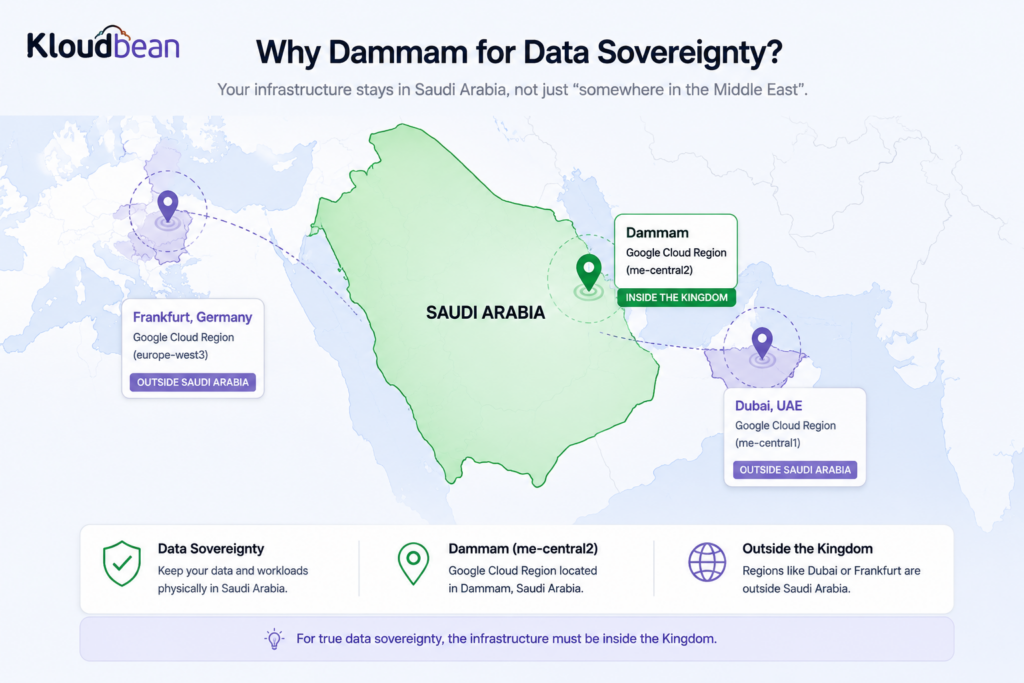
For a business that only cares about latency, several regional locations may be perfectly reasonable. For a business that needs infrastructure physically inside Saudi Arabia, Dammam answers a different requirement.
Moving an existing application into the Kingdom
You don’t need to build a new application just because you want to move your infrastructure to Saudi Arabia. In many cases, the application already works; the infrastructure simply needs to move.
That could mean a WordPress site currently running on GoDaddy or Hostinger, a Laravel application on a VPS, a WooCommerce store on another managed host, or a SaaS product running on a cloud provider outside the Kingdom. The migration process is essentially the same: move the application, move the database, move the files, verify the environment, test everything, and only then switch DNS.
The important part is to treat the migration as more than copying website files. Database connections, environment variables, scheduled jobs, SSL, DNS records, uploaded media, cron jobs, background workers, and third-party integrations all need to be checked before the final cutover.
With KloudBean, the destination can be a managed environment in Google Cloud’s Dammam region. Free migration assistance can help with the move, while the free trial gives you an opportunity to verify the application before making the production DNS change.
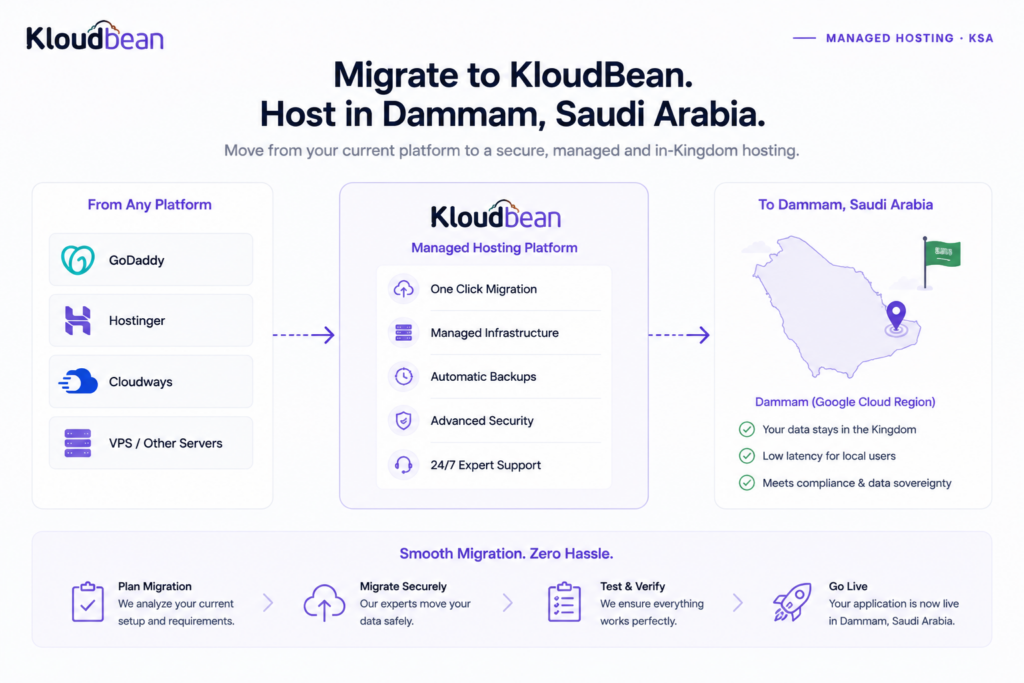
Migration path: GoDaddy / Hostinger / Cloudways / VPS → KloudBean → Dammam, Saudi Arabia.
Who should choose managed hosting in KSA, and who shouldn’t
Managed isn’t automatically right for everyone, and I’d rather you spend the money where it earns its keep. Here’s the honest read on fit.
For most businesses, the goal isn’t to “move hosting.” It is to move production with as little disruption as possible while ending up with an infrastructure model that is easier to operate.
- SMEs and startups without an ops team. If nobody on staff wants to be the sysadmin, managed servers in KSA are the obvious call. You get a production-grade box without hiring for it.
- Agencies with Saudi clients. One dashboard, many client sites, all provably in-Kingdom, is an easy story to tell a local client who asks the residency question. You bill for building, not for babysitting servers.
- Ecommerce and WooCommerce stores. Your buyers are in the Kingdom, checkout latency is money, and customer and payment data is exactly what you want on Saudi soil with backups you didn’t have to script.
- SaaS serving Saudi users. Managed keeps you shipping features while the platform handles patching and uptime, and in-Kingdom hosting becomes a line in your own sales calls.
- Government and enterprise tenders. When residency is in the requirements, a managed in-Kingdom stack gives procurement a clean answer. Heavier needs can extend, on Enterprise, to Kubernetes, autoscaling, custom architectures, and an audit trail.
- You can probably skip managed if you have a real DevOps team that wants deep, unusual control, a custom kernel, or an exotic stack, or the box is a throwaway lab where a wipe costs you nothing. In those cases the control of a raw server is the point, and paying for management is paying someone not to do a job you enjoy.
The pattern underneath all of this: managed hosting is often the experienced choice, not the beginner one. Plenty of people who know Linux perfectly well still pick managed, because they’ve decided their attention is worth more on the product than on the pager. If you’re weighing hosts for the region, how to choose managed cloud hosting lays out the criteria that actually matter, and if you’re specifically comparing platforms, this look at Cloudways alternatives is a fair sanity check.
Backup is not the same thing as disaster recovery
There is an important distinction between having a backup and having a disaster recovery plan. A backup gives you a copy of something. Disaster recovery answers a much harder question: how do we get the business running again when the primary environment is unavailable?
Imagine a production application with a server, database, customer uploads, SSL certificates, DNS configuration, scheduled jobs, and application secrets. If the server disappears tomorrow, restoring one database backup does not automatically recreate the complete service. You still need the application, configuration, networking, storage, and a process for bringing everything back online.
That is why a serious disaster recovery plan starts with an inventory of what actually needs to be recovered. The application needs to be recoverable. The database needs a tested restore path. Uploaded files need their own recovery strategy. Infrastructure configuration needs to be reproducible. DNS and SSL need to be accounted for. And somebody needs to know the order in which everything is brought back.
KloudBean provides several of the infrastructure building blocks required for that approach, including automatic backups, managed databases, object storage, private networking, and managed servers. The exact recovery architecture still depends on the workload and the required Recovery Point Objective (RPO) and Recovery Time Objective (RTO).
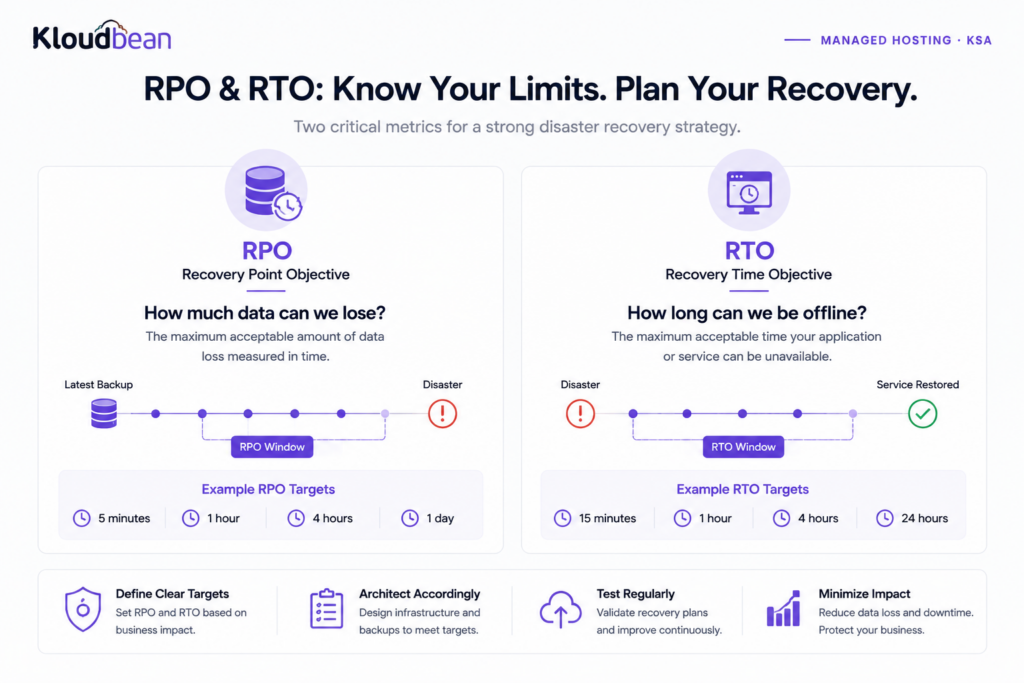
Building a disaster recovery strategy for a Saudi application
For a small website, recovery may simply mean restoring the latest backup onto another server. For an enterprise application, the recovery plan is usually broader. You may need to restore the database, reconnect application servers, recover object storage, restore private networking, update DNS, verify SSL, and confirm that background jobs and integrations are working again.
The first useful exercise is to write down the application’s dependencies. What does the frontend need? Where does the database live? Where are uploaded files stored? Which services need to communicate privately? Which credentials and secrets are required? Which external services are allowed to reconnect? Once those dependencies are known, recovery stops being a vague promise and becomes a sequence of actions.
RPO and RTO make the discussion measurable. RPO asks how much data the business can afford to lose—for example, five minutes, one hour, or one day. RTO asks how long the business can afford to be unavailable. A customer-facing SaaS platform may have very different requirements from a marketing website, and the infrastructure should be designed accordingly.
This is also where Enterprise architecture becomes relevant. Higher availability, multiple application servers, load balancing, custom networking, additional recovery environments, and other resilience measures can be designed around the application’s actual requirements rather than assuming every workload needs the same architecture.
Where managed hosting stops: the honest edges
To keep this trustworthy, here are the boundaries. Kloudbean runs Linux stacks (PHP, WordPress, WooCommerce, Laravel, Node, Python, Ruby, Java, and their databases), not Windows or .NET and IIS. “Managed” means the platform handles the server, the stack, SSL, backups, and patching, while your application code and your data stay yours to export any day you like.
On compliance, be careful how you phrase it in a tender. Hosting in the Dammam region is a genuine, defensible foundation for the infrastructure-shaped parts of PDPL and NCA ECC. It is not a certification a host grants you, and Kloudbean makes no such claim on your behalf. You still own consent, lawful basis, retention, and the rest of the app-level work. And autoscaling and Kubernetes aren’t automatic on a standard plan. They’re part of Enterprise and custom setups, so don’t promise a stakeholder that a normal managed server scales itself. What managed hosting reliably gives a Saudi team is the boring, valuable thing: a production server run properly, in-Kingdom, so the people who built the product can keep building it.
What stays yours when KloudBean manages the infrastructure?
There is a psychological concern with managed hosting that doesn’t get discussed enough: “If you manage my server, do I still control my business?”
Yes. Managed hosting changes who operates the infrastructure. It does not transfer ownership of your application or your data. Your source code remains yours. Your database remains yours. Your customer data remains yours. Your domain remains yours. Your application configuration and business logic remain yours.
What KloudBean takes responsibility for is the infrastructure layer: provisioning, operating system management, the supported application stack, SSL, backups, monitoring, and other platform-level operations. That separation is the entire point of managed hosting.
You should still have an exit plan. Know how to export your database. Know where your application files live. Keep your source code in your Git repository. Understand your DNS records. A good managed platform should make the infrastructure easier to operate without making your business dependent on a black box.
That is the healthiest way to think about managed hosting: you outsource the repetitive infrastructure work, not ownership of the thing you’re building.
Let someone else run the server. Keep shipping.
Launch a fully managed server and database in Google Cloud’s Dammam region (me-central2), keep backups and SSL in-Kingdom, and manage the whole stack from one dashboard. Plans start from $8/mo, Enterprise is custom. Start at kloudbean.com, see options on pricing.
In-Kingdom GCP Dammam region · Managed patching · Automatic backups · Free SSL · Private networking · Free migration assistance · Free trial
FAQ
What is managed hosting in KSA?
Managed hosting in KSA is a server that a platform runs for you inside Saudi Arabia. The provider handles provisioning, the stack, SSL, OS patching, backups, and monitoring, while you own your application and data. On Kloudbean the managed server can sit in-Kingdom on Google Cloud’s Dammam region (me-central2), so the operations are handled and the data stays on Saudi soil.
Who actually runs the server on a managed plan?
The platform does. Provisioning, patching, SSL renewals, firewall, backups, and health monitoring are the platform’s job on a managed plan. You interact with your application, not the bare Linux box. Your code, your data, and your business decisions stay yours, which is the part that never moves regardless of who runs the server.
What does managed include, and what stays mine?
Managed typically includes the operating system, the stack (web server, runtime, database), OS and security patching, SSL issuance and renewal, firewall and intrusion blocking, automatic backups, and monitoring. On Kloudbean that means a Shorewall firewall and Fail2ban on by default, free SSL, and automatic backups from launch. Your application code, your data, and your app-level compliance choices stay yours.
Is managed hosting in Saudi Arabia the same as in-Kingdom hosting?
Not automatically. Managed describes who runs the server. In-Kingdom describes where it physically sits. You get both when the managed server is provisioned in Google Cloud’s Dammam region (me-central2), which is inside Saudi Arabia. A managed server in a Europe region is still managed, just not in-Kingdom, so confirm the region rather than the marketing label.
Managed vs unmanaged: which should a small Saudi team pick?
If nobody on the team wants to be the sysadmin, managed is usually the right call. Unmanaged is cheaper on the invoice but hands you patching, SSL, backups, and the 2am pager. Managed buys those hours and that risk back for a higher sticker price. Choose unmanaged only if you have the ops skill and genuinely want deep control of the server.
Does managed hosting mean I lose control or root access?
You keep control of what matters: your application, your data, your deploys, and your configuration. Managed takes over the operations underneath, which is the point. If you specifically need deep, unusual control over the OS or a custom kernel, that is one of the real cases where an unmanaged server fits better.
Can managed hosting keep my data in-Kingdom?
Yes. When you launch the managed server in Google Cloud’s Dammam region (me-central2), the server, the managed database, and the automatic backups all stay in that region, inside Saudi Arabia. Because the whole stack is managed from one dashboard, there is no separate backup service quietly storing copies in another country.
Does managed hosting make me PDPL compliant?
No, not on its own. Hosting in-Kingdom gives you a strong foundation for the residency and infrastructure parts of PDPL and NCA ECC, but compliance is shared responsibility. The platform provides infrastructure controls; you own consent, lawful basis, retention, disclosures, and data-subject rights at the application level. Managed hosting is not a certificate, and no host grants you one.
How much does managed hosting in KSA cost?
Standard plans start from $8 a month, and Enterprise is custom pricing depending on scale and requirements. In-Kingdom hosting on the Dammam region follows the same plan structure. Cloud pricing changes and the region you pick can affect the underlying cost, so check the current numbers on the pricing page before you commit.
Can you migrate my existing server to managed hosting in the Kingdom?
Yes. Free migration assistance can move an existing site or app onto a managed server in the Dammam region with minimal downtime, and there is a free trial to test the setup first. Your app and data are portable, so moving to managed hosting is a migration, not a rewrite.
Kloudbean MENA · Managed hosting inside the Kingdom, so your team ships instead of patching.